
Cross-Modal Masked Compositional Concept Modeling for Enhancing Visio-Linguistic Compositionality
Authors: Wei Li, Zhen Huang, Xinmei Tian
The authors propose the MACCO framework, which captures cross-modal compositional structures by masking compositional concepts in one modality and reconstructing them using the full context of the other modality.
Paper Summary
Problem
Existing contrastively trained vision-language models (e.g., CLIP) exhibit bag-of-words behavior, struggling to capture object relationships, attribute binding, and word order dependencies, while existing hard negative sample construction methods are costly and noisy.
Method Overview
- Backbone: CLIP-like VLM (ViT + Transformer)
- Key module: 跨模态掩码重建模块,全局到局部语义注入
- Loss: 掩码增强跨模态对齐损失 (MCA),掩码增强模态内正则化损失 (MIR)
Takeaways
Personal understanding — corrections welcome
Experiments demonstrate that this method significantly improves the compositional understanding capability of VLMs, enhances syntactic structure capture, and benefits text-to-image generation and multimodal large language model tasks.
Limitations & Questions
The paper does not explicitly discuss specific limitations; however, the masked reconstruction strategy may increase training computational overhead, and generalizability requires further verification.
Reading Notes
Personal reading notes. Original paper: arXiv:2606.13288v1.
arxiv_id: 2606.13288v1
arXiv Paper Reading Note: Cross-Modal Masked Compositional Concept Modeling for Enhancing Visio-Linguistic Compositionality
Paper Overview
- Paper ID: 2606.13288v1
- Title: Cross-Modal Masked Compositional Concept Modeling for Enhancing Visio-Linguistic Compositionality
- Authors: Wei Li, Zhen Huang, Xinmei Tian
- Affiliation: University of Science and Technology of China
- Core Contribution: Proposed the MACCO framework, which enhances the compositional understanding capabilities of Vision-Language Models (VLMs) through cross-modal masked concept reconstruction, without requiring explicit hard negative sample construction.
Research Background and Motivation
The authors point out that contrastive training Vision-Language Models (VLMs), represented by CLIP, have made significant progress in learning joint image-text representations but still face challenges in compositional understanding. The paper argues that these models often exhibit “bag-of-words” behavior, struggling to capture object relationships, attribute-object binding, and word order dependencies.
For example, models may fail to distinguish between “a horse eating grass” and “grass eating a horse,” or confuse descriptions like “a black dog and a white cat” with “a white dog and a black cat.” The authors analyze that this limitation stems not only from optimization relying on global single-vector representations but also from the failure to fully utilize the rich compositional information inherent in paired image-text data.
Existing improvement methods mostly focus on constructing hard negative samples with subtle semantic differences, such as rule-based templates, LLM-generated captions, or synthetic scenes. However, the authors note that these methods are often costly, noisy, and may cause models to overfocus on superficial patterns of specific negative samples, potentially leading to incorrect ranking of semantically equivalent captions. Therefore, the paper raises a key question: Beyond mining hard negative samples, can a training framework be designed to better utilize the inherent aligned compositional information in existing image-text pairs to improve VLM compositionality?
Core Method: MACCO Framework
To address the above issues, the authors propose the MACCO (MAsked Compositional Concept MOdeling) framework. The core idea of this framework is to mask compositional concepts in one modality and reconstruct them based on the complete context information from the other modality.
Cross-Modal Masking and Reconstruction
As shown in Figure 1, the MACCO method masks compositional concept words (e.g., actions, attributes) in the text modality and reconstructs them using complete image features; conversely, it masks the corresponding image regions in the image modality and reconstructs them using complete text features. This design aims to enable the model to capture and align cross-modal compositional structures more effectively.

During the reconstruction process, the authors particularly emphasize improving the capabilities of the text encoder. Since previous studies have shown limitations in text encoders of contrastive VLMs regarding capturing object relationships and attribute binding, the authors stop the gradients of image features in both predictors during training (stop-grad), ensuring the loss function focuses on optimizing text representations.
Auxiliary Loss Functions and Architecture
To facilitate this masked cross-modal reconstruction, the paper introduces two new auxiliary objective functions, with the overall architecture shown in Figure 2.

-
Masked-augmented Cross-Modal Alignment Loss (MCA): This loss integrates the global features of masked text or masked images into the cross-modal contrastive learning process to promote effective cross-modal reconstruction and alignment learning.
-
Masked-augmented Intra-Modal Regularization Loss (MIR): This loss is used to regularize the global features of masked instances within each modality to prevent representational collapse.
Additionally, to better constrain global features and enrich the context global semantics of local tokens during reconstruction, the authors introduce a parameter-free global-to-local semantic injection operation. During the inference stage, the image and text predictors are removed, retaining only the encoder parts.
Experimental Results and Analysis
The authors conducted extensive experiments on five widely used vision-language compositional benchmarks and validated them using four different backbones. Experimental results show that the MACCO method significantly enhances the compositionality of VLMs.
Improvement in Compositionality and Syntactic Structure
In-depth analysis reveals that MACCO not only improves compositional understanding capabilities but also enhances the model’s ability to capture syntactic structures and semantic nuances. The embeddings generated by the model are more concept-aware, exhibit stronger robustness to semantic invariant perturbations, and better preserve fine-grained language information.
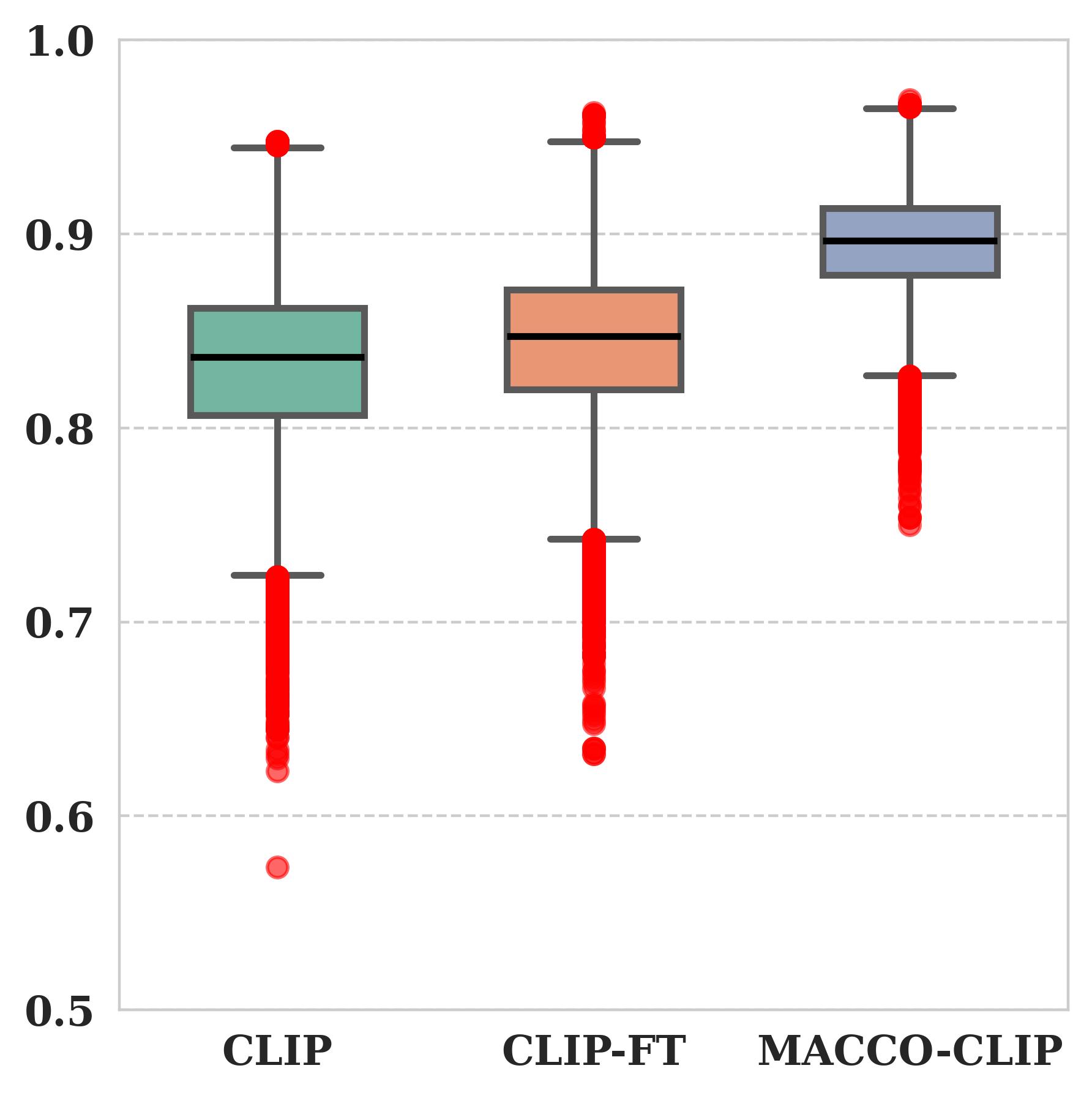
Embedding Similarity Distribution Analysis
The paper also analyzes the similarity distribution between embeddings through visualization. As shown in Figure 3, the authors display the distribution of embedding similarities under different conditions, which helps understand the changes in the representation space when distinguishing different compositional concepts after introducing MACCO.
Downstream Task Gains
In addition to benchmark testing, the paper further experiments show that the improved compositionality benefits the following tasks:
- Text-to-Image Generation
- Multimodal Large Language Models
Furthermore, the authors note that the MACCO framework is compatible with existing hard negative mining methods, and combining them can yield additional performance gains.
Summary
This paper addresses the deficiencies of existing vision-language models in compositional understanding by proposing the MACCO framework, which does not require explicit hard negative sample construction. Through cross-modal masked concept reconstruction and the introduction of two auxiliary losses, MCA and MIR, this method effectively utilizes compositional information in paired data. Experiments prove that this method not only improves model performance on compositional benchmarks but also enhances syntactic structure capture capabilities, benefiting downstream multimodal generation and understanding tasks. The code is open-sourced for reproduction and extension by subsequent research.
This note was included in the arXiv daily digest 20260616. More roundups at blog archive .