Reasoning for Mobile User Experience with Multimodal LLMs: Task, Benchmark, and Approach
Authors: Ruichao Mao, Zhou Fang, Teng Guo, Hao Yang, Yaping Li
The authors propose the UXBench benchmark and the UI-UX model, aiming to evaluate and enhance the user experience reasoning capabilities of multimodal large language models on UI screenshots. UXBench contains 2,000 VQA samples covering 8 tasks, while UI-UX is based on Qwen3-VL and enhances the reasoning process through reinforcement learning.
Paper Summary
Problem
Existing UI benchmarks primarily focus on visual perception tasks, lacking fine-grained UX reasoning evaluation based on UI screenshots, which makes it difficult for models to detect issues caused by misalignment between design specifications and user mental models.
Method Overview
- Backbone: Qwen3-VL-4B-Thinking
- Key module: 奖励路由机制、不对称转换奖励
- Loss: GRPO 强化学习损失
Takeaways
Personal understanding — corrections welcome
Experiments in the paper indicate that mainstream MLLMs have fundamental limitations in UI reasoning capabilities. UI-UX achieves SOTA performance on UXBench by dynamically balancing perception and reasoning and suppressing redundant steps.
Limitations & Questions
The benchmark dataset size is only 2,000 samples, relies on expert annotation for validation, and the model's generalization capability in more diverse UI scenarios needs further verification.
Reading Notes
Personal reading notes. Original paper: arXiv:2606.13192v1.
arXiv Paper Reading Note: Reasoning for Mobile User Experience with Multimodal LLMs
1. Background and Motivation
The paper points out that in modern human-computer interaction systems, the key to success has shifted from mere functional implementation to the quality of User Experience (UX). UX encompasses usability, perceptual consistency, and functional clarity, involving users’ emotional, cognitive, and behavioral responses throughout the entire interaction journey. Although Multimodal Large Language Models (MLLMs) have made progress in UI understanding, generation, and user sentiment recognition, research on evaluating UX based on UI screenshots remains immature.
The authors argue that existing UI benchmarks (such as Screen2Words, Mobile-bench, etc.) primarily focus on visual perception tasks (e.g., element detection, layout parsing) and lack goals based on behavioral outcomes, cognitive psychology, and trust dynamics. This leads to current models struggling to detect design patterns that trigger user errors or negative emotions. Furthermore, UX issues often stem from a misalignment between design specifications and user mental models, rather than visible layout defects, posing a fundamental challenge for multimodal models to move from “perceiving interfaces” to “inferring experiences.”
2. UXBench Benchmark
To address the aforementioned evaluation gap, the authors propose UXBench, a new multimodal benchmark containing 2,000 VQA data samples, designed to evaluate the ability of MLLMs to perform UI-based reasoning.
2.1 Task Design and Dimensions
UXBench is based on real-world UI screenshots and includes 8 fine-grained diagnostic tasks. These tasks require models to perform fine-grained UX problem diagnosis regarding layout relationships, visual hierarchy, and content consistency. The paper categorizes UX problems into three dimensions:
- Usability
- Efficiency
- Trustworthiness
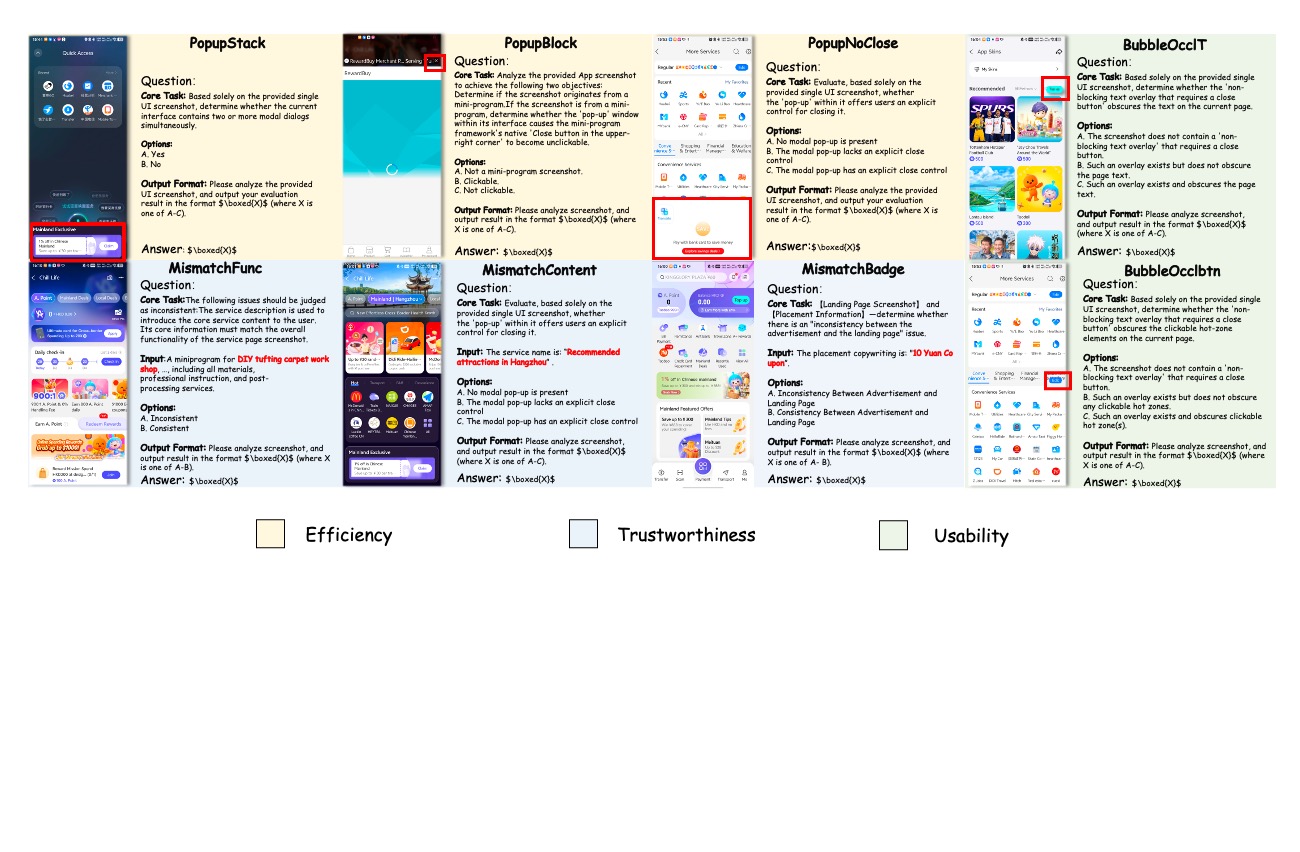
As shown in Figure 1, UXBench samples cover the three dimensions mentioned above. Each case requires visual-semantic reasoning to detect UX issues (e.g., overlapping modal windows, deceptive content, missing control buttons). Red bounding boxes indicate the ground truth defect areas used for quantitative evaluation. Tasks involve inferring experience consequences beyond pixel-level perception.
2.2 Data Distribution and Construction
The paper ensured label consistency through large-scale MLLM-assisted annotation combined with two rounds of verification by four senior UX experts. Figure 2 shows the data distribution in UXBench, reflecting the sample composition under different task categories and dimensions.
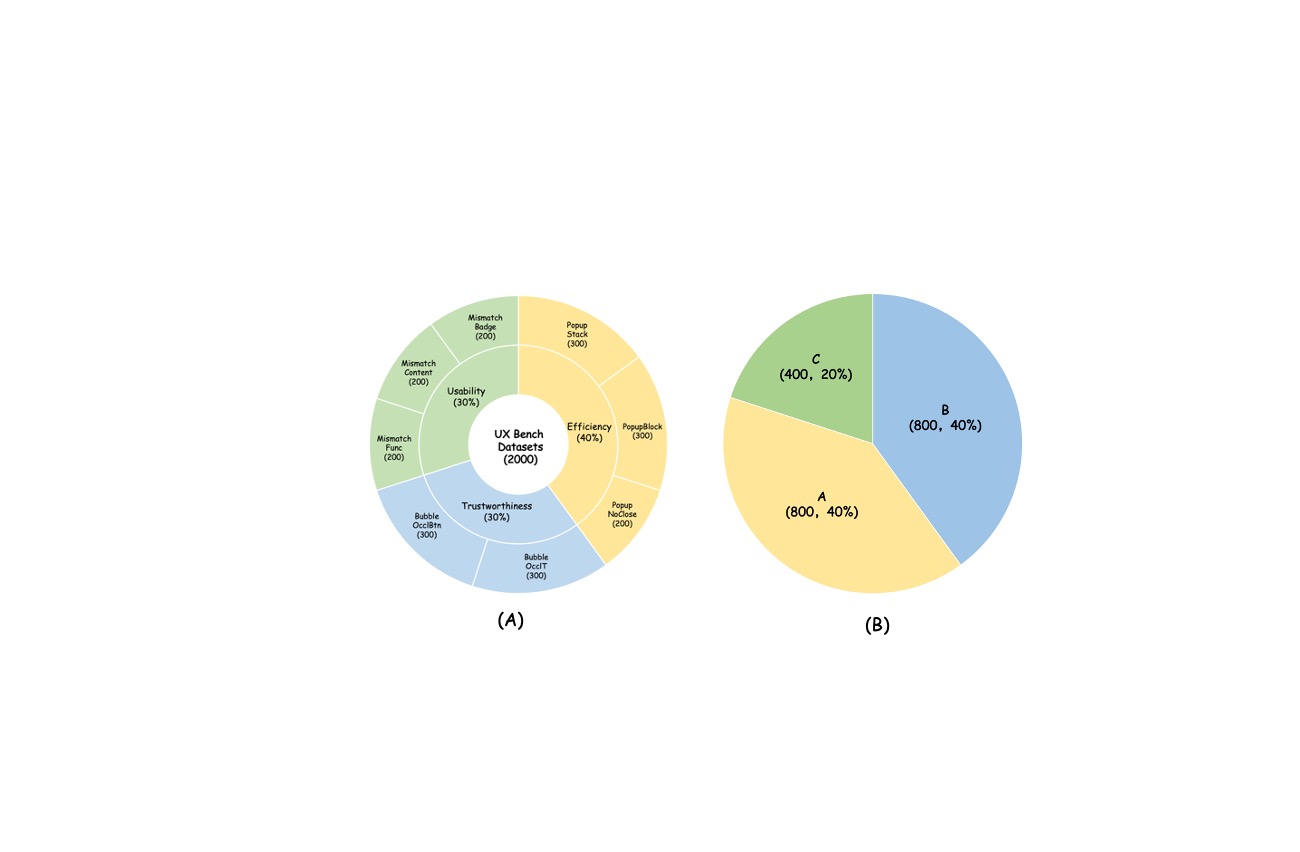
The authors note that existing methods typically rely on manually annotated instruction-action pairs or simplify UX evaluation to binary classification, ignoring the multidimensionality and context-dependency of UX issues. Each task in UXBench is designed as a multiple-choice question with two or three options, requiring causal reasoning and mapping to design principles rather than simple keyword matching.
3. UI-UX Model Architecture
To bridge the gap in current models’ UI reasoning capabilities, the authors propose UI-UX, an MLLM based on the Qwen3-VL-4B-Thinking foundation model and enhanced through Reinforcement Learning (RL).
3.1 Training Process
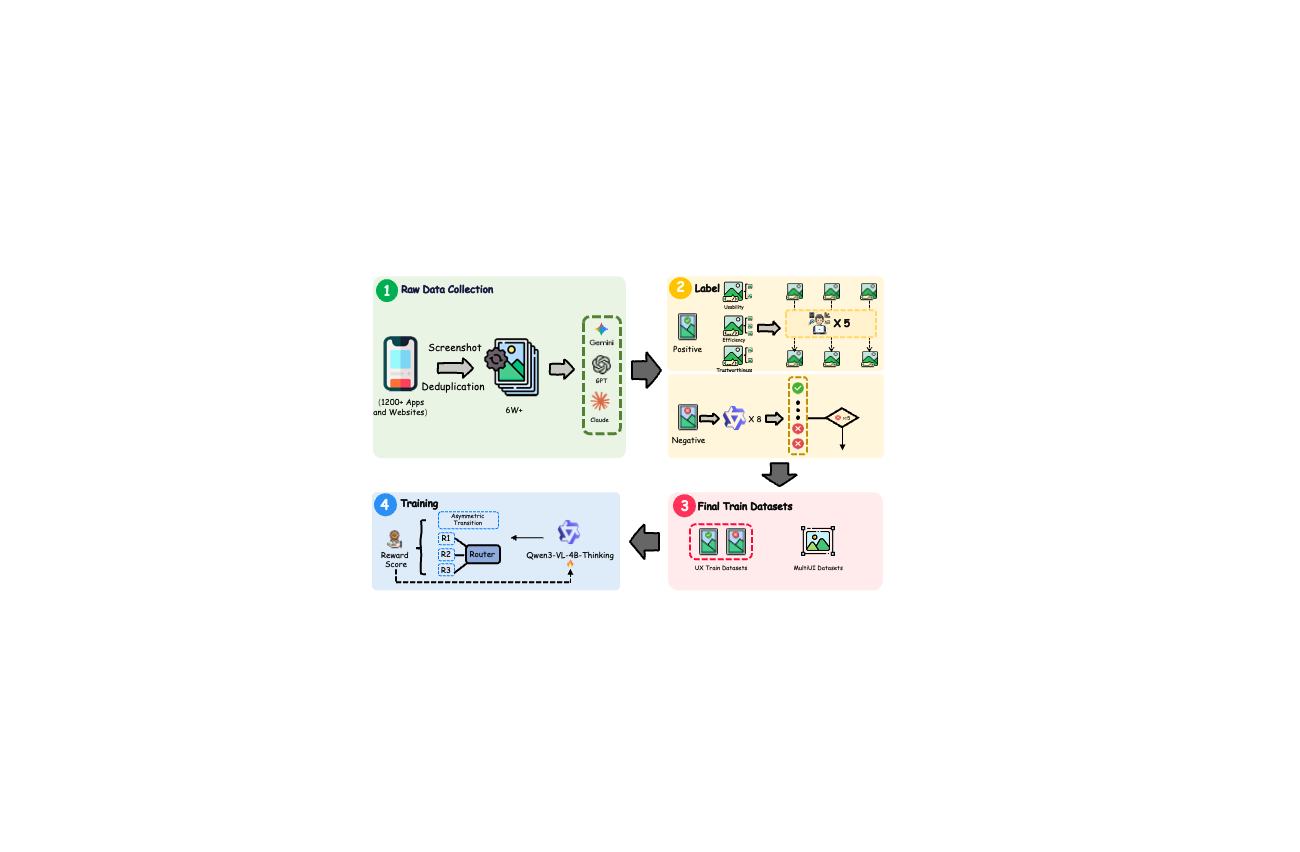
The training process of UI-UX is shown in Figure 3. This framework requires no manual preference annotation and performs end-to-end optimization via the GRPO algorithm. The training process includes raw data collection, data augmentation, a reward routing mechanism, and the application of asymmetric transition rewards.
3.2 Key Innovations
UI-UX introduces two key innovations to improve reasoning performance:
-
Reward Routing Mechanism: This mechanism dynamically balances perceptual understanding and logical reasoning during inference. Accuracy rewards are used for UX diagnostic tasks, ROUGE-L scores for semantic alignment in general UI understanding, and hit rewards for localization tasks.
-
Asymmetric Transition Reward: This mechanism aims to suppress redundant or insufficient reasoning steps, thereby reducing inference latency.
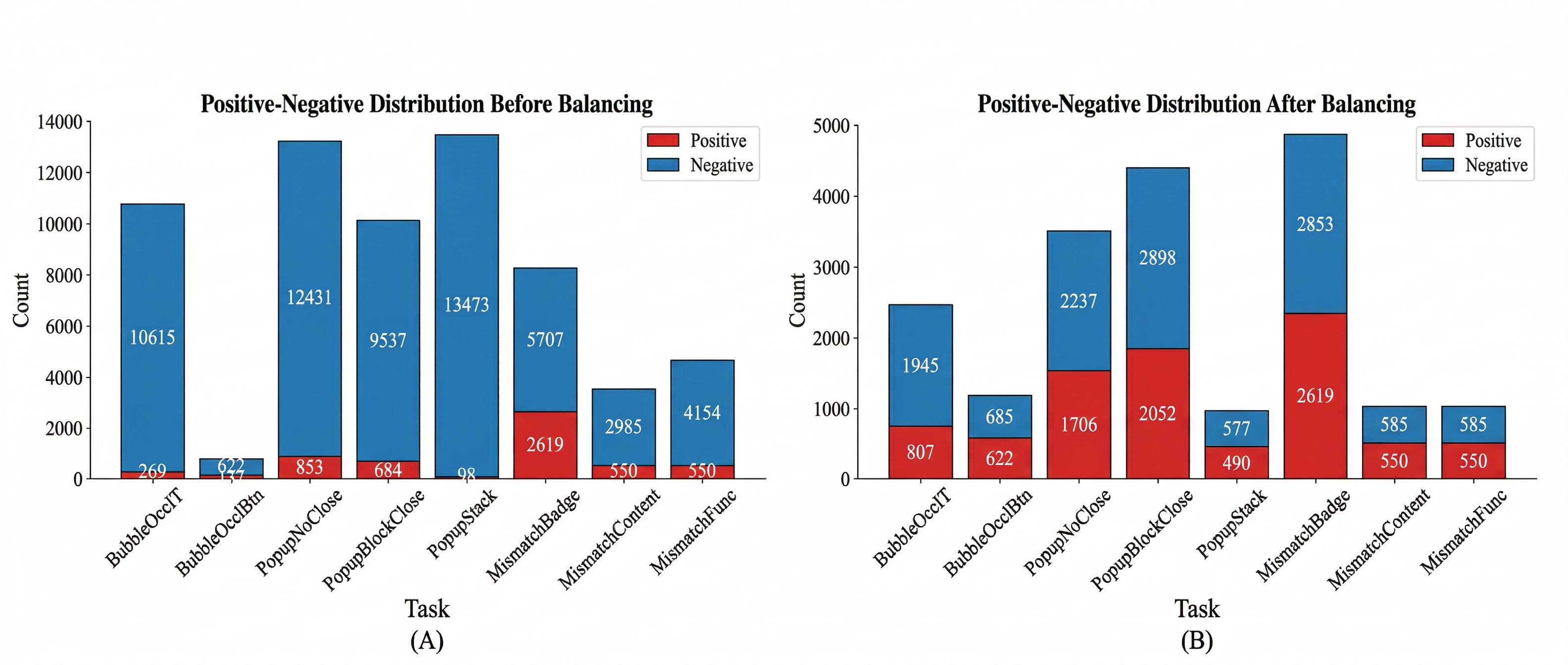
Additionally, addressing the scarcity of positive samples and extreme class imbalance in real-world scenarios, the authors introduced hard negative sampling and semantic preservation augmentation strategies. Figure 4 shows the distribution of positive and negative samples before and after balancing, demonstrating the improvement of data balancing strategies on the model training data distribution.
4. Experimental Results and Analysis
The paper conducted extensive evaluations on mainstream MLLMs, showing that they still have fundamental limitations in UI-based reasoning capabilities. The UI-UX model achieved State-of-the-Art (SOTA) performance on UXBench.
- Accuracy: UI-UX achieved an accuracy of 0.7963 on UXBench.
- Comparative Performance: This score surpasses Claude-4.5-Sonnet’s 0.6550.
- Generalization: Experiments indicate that UI-UX demonstrates strong generalization capabilities across diverse UI tasks.
- Efficiency: The model maintains low inference latency while sustaining high performance.
The authors emphasize that aligning vision and text alone is insufficient for true UX understanding; models need to advance in semantic association, counterfactual reasoning, and intent modeling. UI-UX effectively addresses these issues through a reinforcement learning framework, achieving MLLM UX reasoning performance that surpasses human experts.
5. Conclusion
The main contributions of this paper are:
- First UX Reasoning Benchmark: Proposed UXBench, defining 8 fine-grained, evaluable, user-centric UI diagnostic tasks, filling a critical gap in the field.
- Reward Routing Strategy: Introduced hard negative sampling and semantic preservation augmentation strategies to address sample scarcity and class imbalance issues in real-world scenarios.
- Efficient Reasoning Model: The proposed UI-UX model combines reward routing and overthinking penalties to achieve low-latency, high-robustness UX reasoning capabilities.
The paper suggests that future research needs to further focus on the leap from visual perception to experience inference to support smarter UI design evaluation, automated testing, and design assistance systems.
This note was included in the arXiv daily digest 20260616. More roundups at blog archive .