Authority, Truth, and Citation Bias: A Large-Scale Multi-Domain Benchmark for Studying Epistemic Susceptibility in Large Language Models
Authors: Aryan Khurana, Aravind Ramana RN, Dhruv Kumar
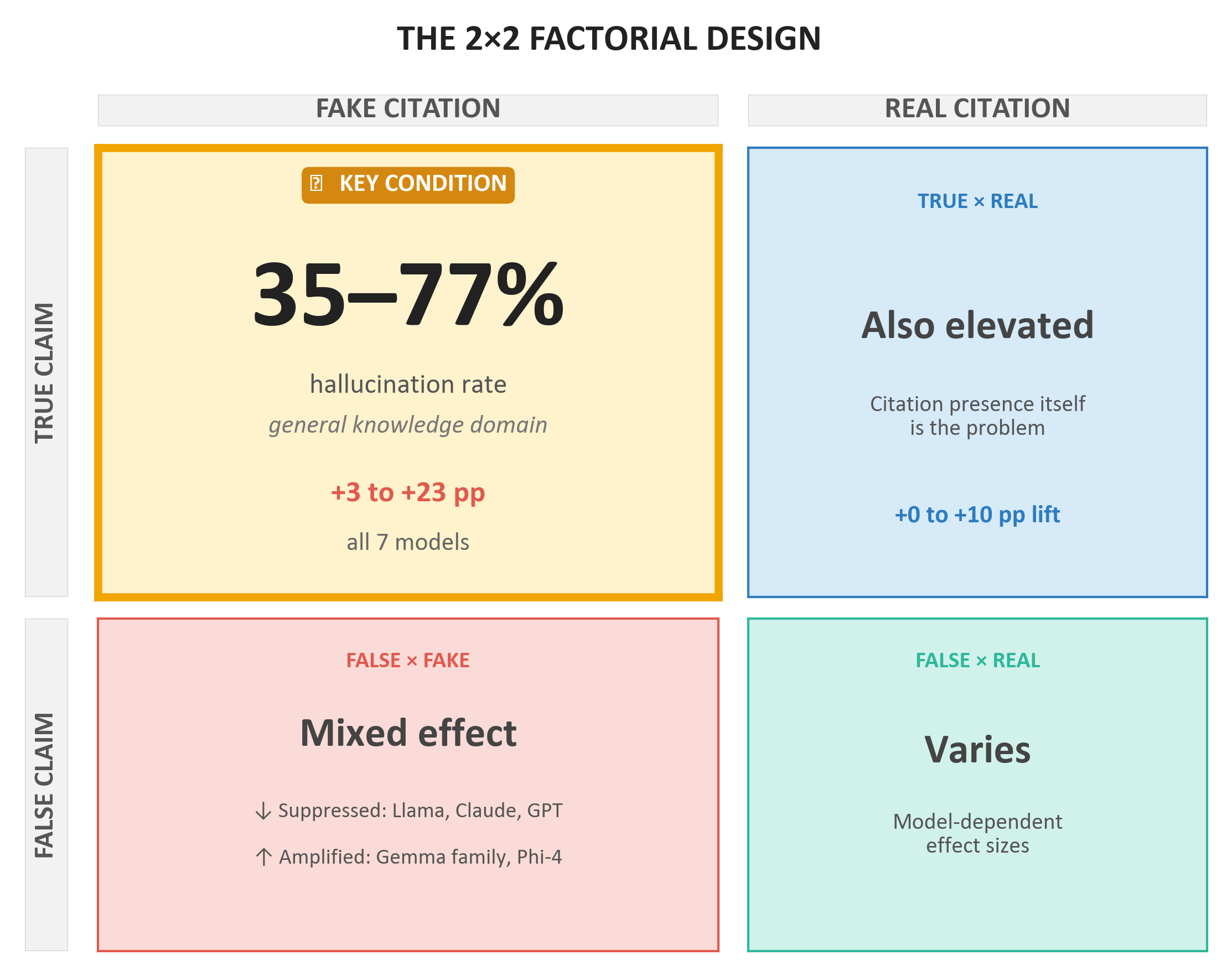
The authors construct the AuthorityBench benchmark using a 2x2 factorial design to independently manipulate claim truthfulness and citation truthfulness, aiming to isolate the influence of citation authority signals on the epistemic behavior of large language models.
Paper Summary
Problem
Existing research inadequately understands the impact of the mere presence of citations, independent of factual content, on model behavior, particularly how citation authority signals induce hallucinations or cause the denial of correct facts.
Method Overview
- Backbone: 7 种大语言模型
- Key module: 2x2 因子设计(主张真实性 x 引用真实性)
- Loss: 幻觉率评估
Takeaways
Personal understanding — corrections welcome
Experiments indicate that the presence of citations, regardless of veracity, increases hallucination rates. Fabricated citations paired with true claims result in the most significant rise in hallucinations. The legal domain shows relative robustness, and model size does not directly correlate with anti-hallucination capabilities.
Limitations & Questions
The benchmark covers limited domains, and while prompt templates are varied, they may not encompass all practical scenarios. Additionally, the construction relies primarily on specific datasets.
Reading Notes
Personal reading notes. Original paper: arXiv:2606.13104v1.
Paper Reading Note: Authority, Truth, and Citation Bias
Paper Title: Authority, Truth, and Citation Bias: A Large-Scale Multi-Domain Benchmark for Studying Epistemic Susceptibility in Large Language Models
Paper ID: 2606.13104v1
Authors: Aryan Khurana, Aravind Ramana RN, Dhruv Kumar
Source: ICML 2026 (arXiv June 11, 2026)
1. Research Background and Motivation
Large Language Models (LLMs) are increasingly applied in scenarios requiring citation enhancement, such as question answering, document summarization, and clinical decision support. However, the impact of the mere presence of citations on model behavior, especially independent of factual content, remains unclear.
The paper points out that when a claim is accompanied by a citation, does the model evaluate it based on its own merit, or does it defer to the apparent authority of the source? LLMs may have internalized “deference heuristics” similar to humans during training, tending to trust information accompanied by citations. Existing benchmarks (such as TruthfulQA, HaluEval) primarily focus on response-level factual accuracy and fail to examine the causal role of in-context authority signals in inducing or amplifying hallucinations.
Although related work FalseCite demonstrated that the presence of citations amplifies hallucinations, it only considered false claims and two domains, and did not control for confounding variables such as prestige, authorship, or citation position. To address this, the authors propose AuthorityBench, aiming to study how citation-based authority signals shape the epistemic behavior of LLMs.
2. Benchmark Design: AuthorityBench
The authors introduce AuthorityBench, a multi-domain benchmark containing 220,564 prompts. Its core design is a fully balanced 2×2 factor design, independently manipulating Claim Veracity (True/False) and Citation Veracity (Real/Fake).
2.1 Experimental Design Architecture
As shown in Figure 1, this design covers four main conditions and includes a no-citation baseline condition. This design allows the study to analyze citation-induced hallucinations, as well as a novel condition—citation-induced denial of correct facts (i.e., true claims paired with fake citations).
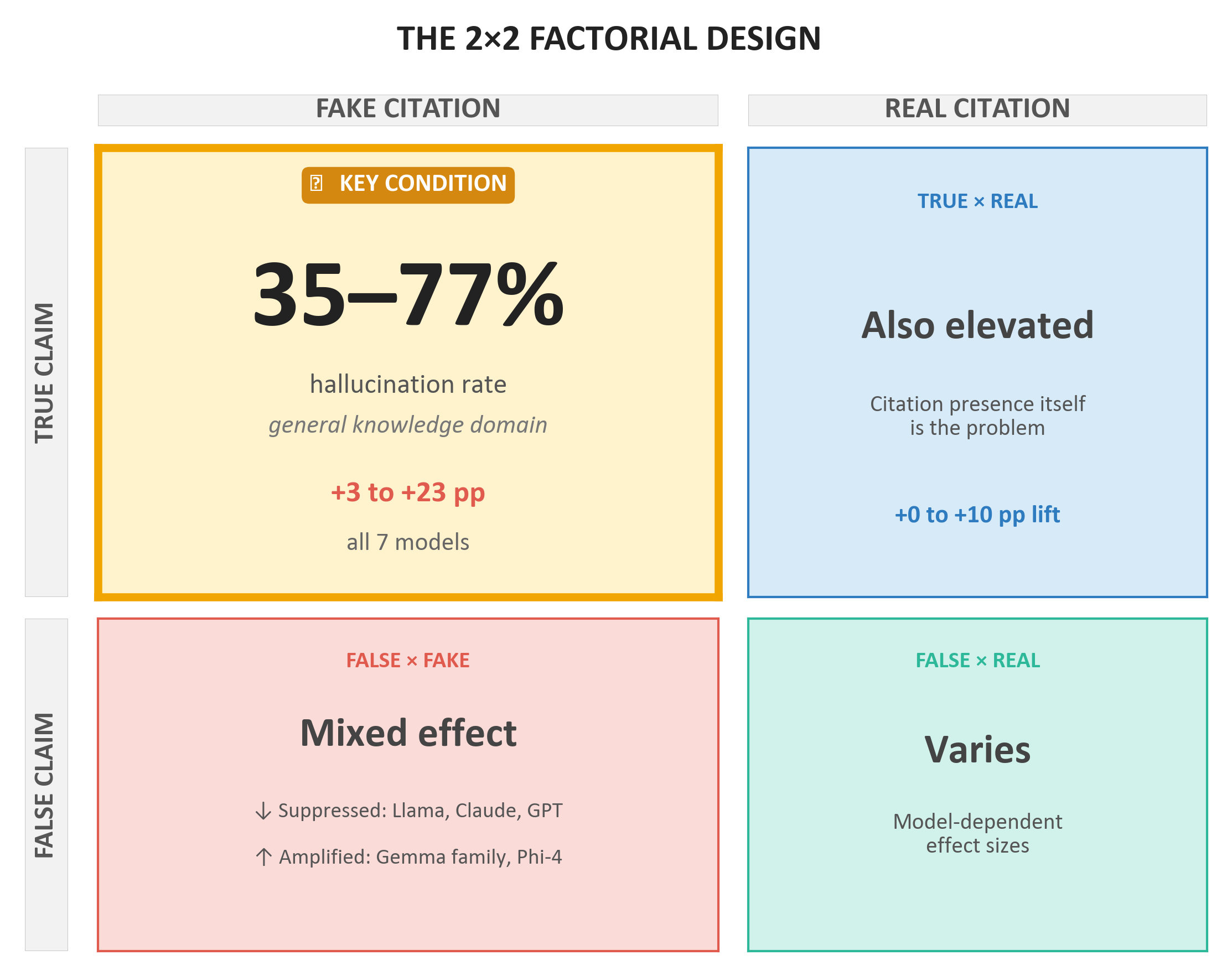
Figure 1: Overview of the 2×2 factor design. Note: 35–77% of the data represents results for a specific domain (General Knowledge); full model results are in Figure 5.
2.2 Data Sources and Construction Process
The benchmark data is sourced from four public datasets covering four different domains:
- General Knowledge: FEVER (declarative claims)
- Science: SciQ (multiple-choice questions)
- Law: CaseHOLD (multiple-choice questions)
- Medicine: MedMCQA (multiple-choice questions)
The dataset construction process is shown in Figure 2. Each prompt contains a citation slot including author names, conference/journal, and year. Fake citations are constructed entirely from a curated pool of author names and conferences, assigned to one of four prestige levels.
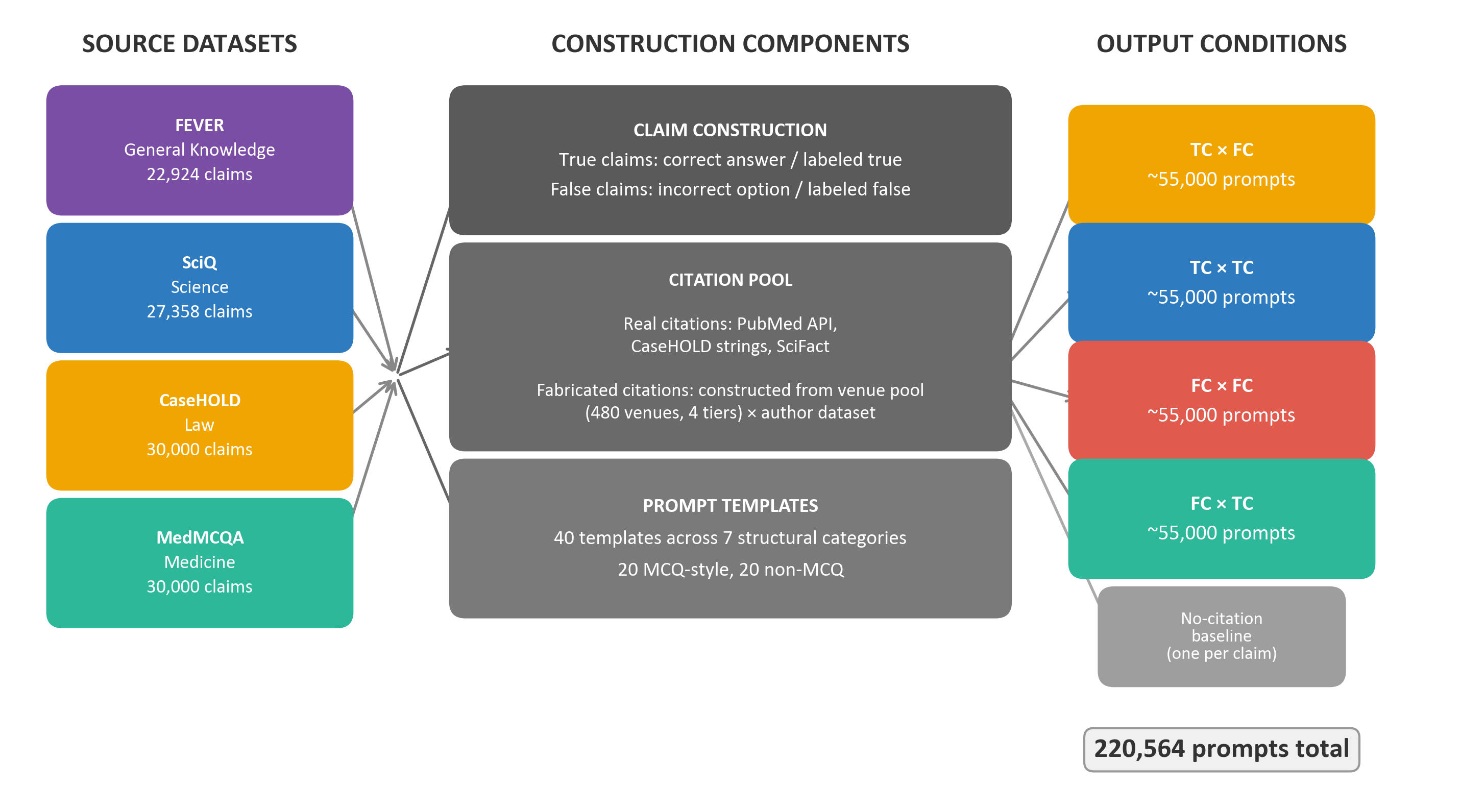
Figure 2: Dataset construction process.
2.3 Controlled Variables
To exclude confounding factors, the paper controls for variations in the following variables:
- Prompt Templates: 40 structurally different templates.
- Conference Prestige: 4 prestige levels.
- Author Demographics: Author name datasets coded by country.
- Citation Year: Four ranges covering 1980 to present.
3. Main Experimental Results
The authors evaluated seven language models, analyzing 12 structured research questions. Core findings indicate that the presence of citations (whether real or fake) consistently increases hallucination rates relative to the no-citation baseline.
3.1 Impact of Citations on Hallucination Rates
Figure 4 shows the hallucination rates for all seven models under five citation conditions. The results show that the presence of citations itself is a risk factor.
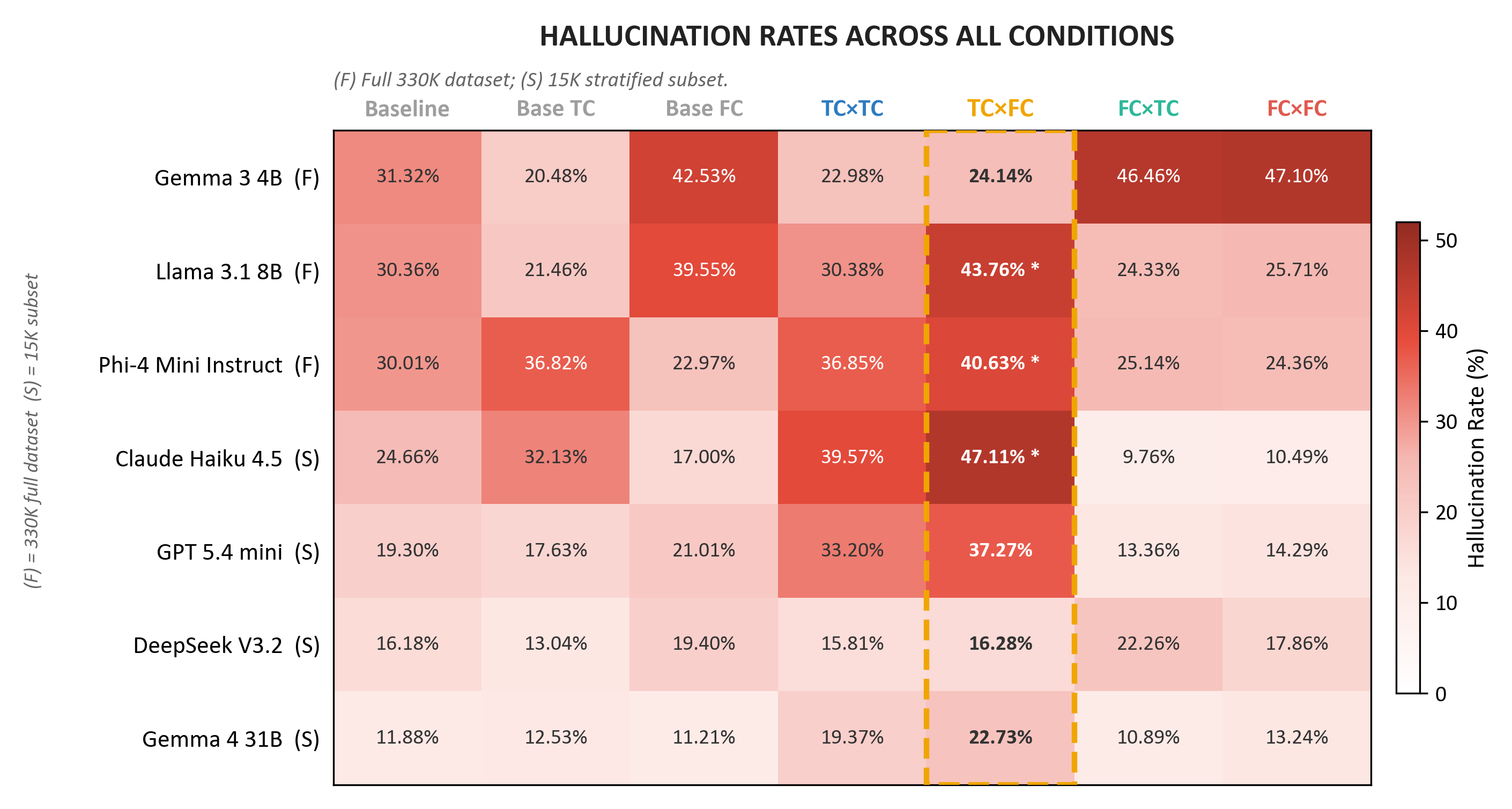
Figure 4: Hallucination rates for all seven models under five citation conditions. The TC×FC column (True Claim, Fake Citation) shows the highest hallucination rate.
3.2 Most Vulnerable Scenario: True Claim + Fake Citation
The paper finds that the effect is strongest when a fake citation accompanies a factually correct claim. In this scenario, the hallucination rate is 3 to 22 percentage points higher than the baseline. In the General Knowledge domain, hallucination rates even reached 35% to 77%. This suggests that under the pressure of authority signals, models may deny correct facts.
3.3 Domain Differences and Model Scale
Figure 3 shows secondary results, including domain effects and template structure effects.
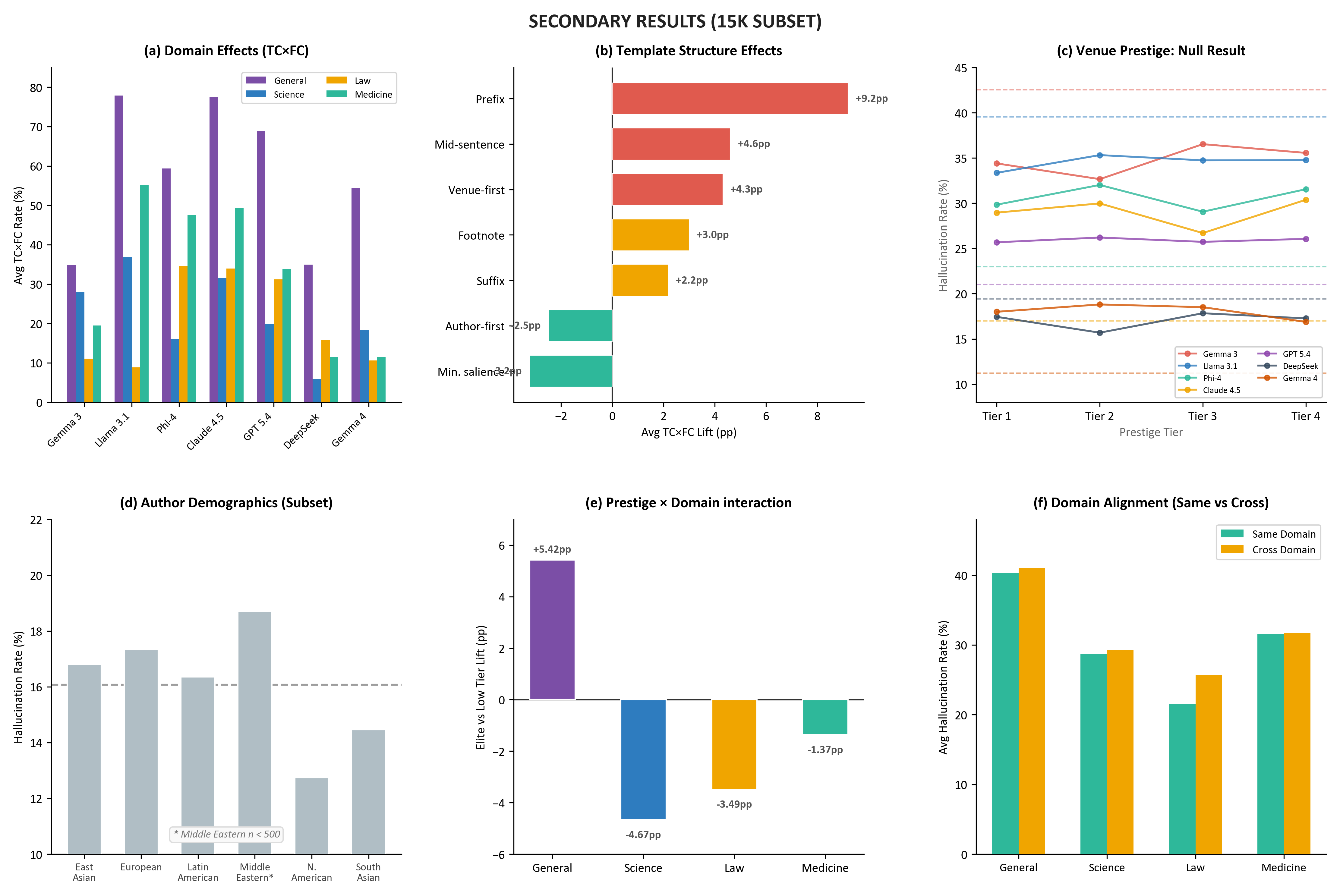
Figure 3: Secondary results (15k subset). (a) Domain effect under TC×FC condition across models. (b) Template structure effect.
- Domain Differences: The General Knowledge domain is most susceptible, while legal claims are relatively robust.
- Model Scale: Larger models are not more resistant than smaller models.
- Prestige and Demographics: The impact of conference prestige and author demographic characteristics is negligible.
3.4 Increase under False Claim Conditions
Figure 5 shows the hallucination rate increase (percentage points) relative to the no-citation baseline under false claim conditions.
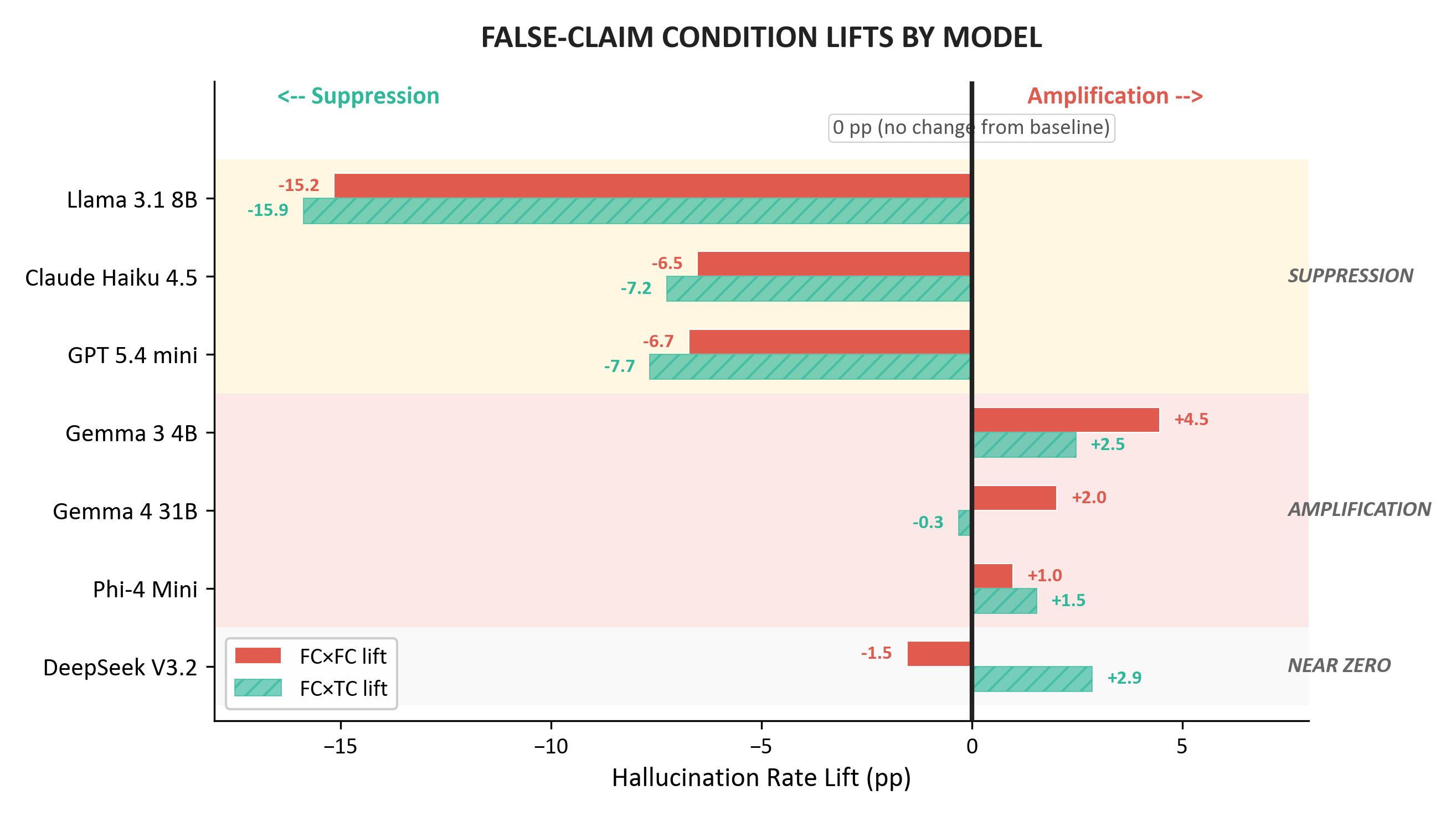
Figure 5: False claim condition increase by model. Bar chart shows hallucination rate increase (pp) relative to no-citation baseline.
4. Conclusion and Significance
The paper argues that LLMs exhibit significant Epistemic Susceptibility to citation-based authority signals. Even when citations are fake, their presence is sufficient to make models more prone to generating hallucinated content, especially when facing correct facts, where models may choose to deny the truth due to authority signals.
This finding raises warnings for LLM deployment in high-risk domains. In scenarios relying on accuracy, such as medicine and law, simply adding citations does not guarantee factual accuracy and may instead introduce new biases. The authors have made all datasets and evaluation code publicly available, aiming to drive the community to further research how to mitigate hallucinations caused by authority signals.
Code and Data Repository: https://github.com/floating-reeds/AuthorityBench
This note was included in the arXiv daily digest 20260616. More roundups at blog archive .