
Dynamic Linear Attention
Authors: Xin Wang, Hui Shen, Boyuan Zheng, Xueshen Liu, Minkyoung Cho
The authors propose the Dynamic Linear Attention (DLA) framework, which employs information-aware dynamic state merging and capacity-bounded memory modeling to address the inability of fixed state merging strategies in existing linear attention methods to adapt to dynamic token importance. The method adaptively determines state boundaries based on token-level information changes, preserving high-resolution representations at semantic transitions while compressing stable regions.
Paper Summary
Problem
Existing linear attention methods rely on fixed state merging strategies for long-context modeling, assuming uniform sequence information density. This leads to critical tokens being compressed prematurely and irrecoverably, causing error accumulation and performance degradation over long sequences.
Method Overview
- Backbone: Linear Attention Models (e.g., Mamba-2, Gated DeltaNet)
- Key module: Information-Aware Dynamic State Merging, Capacity-Bounded Memory Modeling
- Loss: 标准预训练损失
Takeaways
Personal understanding — corrections welcome
Experiments demonstrate that DLA outperforms state-of-the-art methods (e.g., Log-Linear Attention) across 16 datasets and achieves performance comparable to full-attention Transformers on Mamba-2. The dynamic merging mechanism effectively balances memory efficiency with representational capacity, avoiding information loss inherent in fixed strategies.
Limitations & Questions
The computational overhead of dynamic state merging, such as state information score calculation, and its actual latency impact on extremely long sequences require further verification; additionally, the sensitivity of the threshold parameter τ is not discussed in detail.
Reading Notes
Personal reading notes. Original paper: arXiv:2606.10650v1.
Dynamic Linear Attention Reading Notes
1. Background and Motivation
The scalability of Large Language Models (LLMs) in long-context settings is primarily limited by the quadratic computational and memory complexity of standard attention mechanisms. To address this issue, Linear Attention mechanisms have become a research hotspot due to their sub-quadratic complexity. However, to improve representation capability over long sequences, existing multi-state linear attention methods (such as Log-Linear Attention) typically divide historical context into blocks and summarize them into compact memory states.
The paper points out that existing multi-state linear attention methods suffer from significant deficiencies. These methods rely on fixed state merging strategies (e.g., fixed block sizes or rule-based merging schedules) and cannot adapt to the non-uniform and dynamically evolving information structures within long sequences. This design implicitly assumes that information density in the sequence is uniform, leading to an inability to adapt to dynamically emerging semantic shifts. Key tokens may be absorbed too early into coarse summaries, and once heterogeneous tokens are compressed into a single state, their individual contributions cannot be recovered, resulting in error accumulation over long sequences.
Therefore, the authors argue that effective long-context linear attention requires memory modeling mechanisms that possess both “information awareness” and “capacity control.”
2. Method Details: Dynamic Linear Attention (DLA)
To address the aforementioned challenges, the authors propose the Dynamic Linear Attention (DLA) framework. DLA is an information-aware linear attention framework capable of dynamically constructing a set of compact memory states to achieve efficient long-context modeling.
2.1 Overall Architecture
The paper illustrates the overall overview of DLA in Figure 1. Unlike previous methods that rely on fixed time scheduling or predefined block boundaries, DLA adaptively determines state granularity based on token-level information changes.

The specific process is as follows:
- Sequential Processing: Tokens are processed sequentially.
- State Information Scoring: For each new token, DLA calculates a lightweight “State Information Score,” measuring its representational change relative to the recent memory state.
- Dynamic Merging: Tokens with low information change are merged into the current state, while tokens exhibiting significant drift initiate a new state. This allows the model to perform fine-grained modeling around semantic transitions while aggressively summarizing stable token spans.
- Capacity Limitation: To limit memory and computation, DLA maintains a capacity-limited state cache. When the cache reaches its maximum size, DLA selectively merges adjacent low-information-density states, maintaining temporal order while minimizing information loss.
2.2 Core Components
DLA mainly includes two key innovations:
-
Information-Aware Dynamic State Merging This mechanism dynamically determines state boundaries based on token-level information changes. Algorithm 1 describes this process: calculate the difference between the current token state and the previous state (using normalized Frobenius norm). If the difference exceeds a threshold , a new state is created; otherwise, the current token is merged into the existing state.
-
Capacity-Bounded Memory Modeling This mechanism maintains a fixed-size, time-ordered state cache. When the cache is full, the system merges adjacent low-information states, ensuring that computational and memory costs during inference are predictable.
2.3 Comparison with Existing Methods
The paper visually contrasts Standard Linear Attention, Log-Linear Attention, and Dynamic Linear Attention (DLA) in Figure 2.
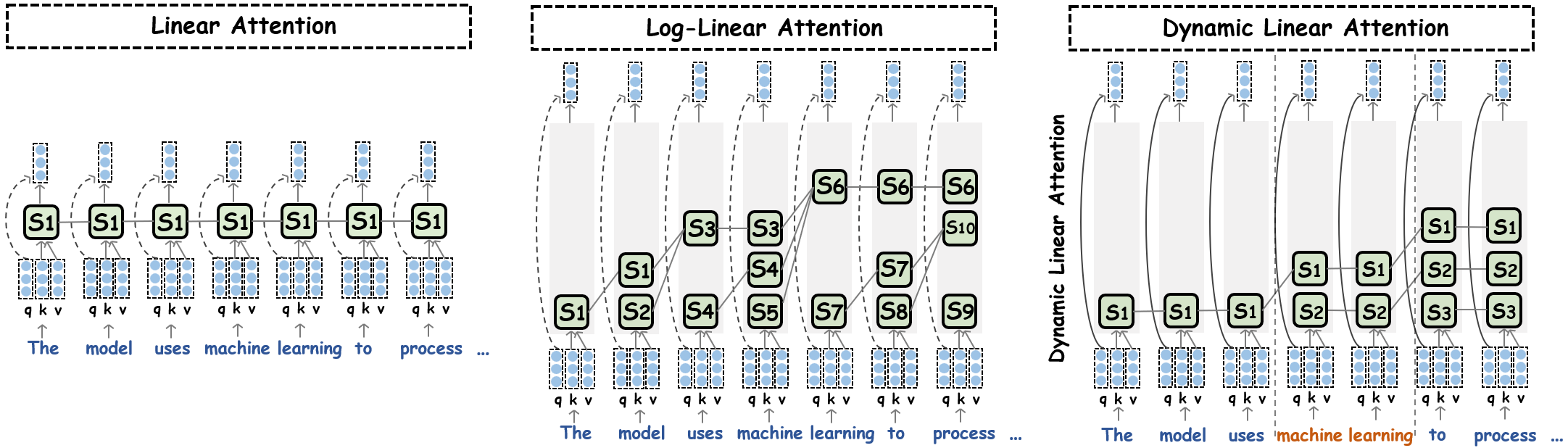
- Standard Linear Attention (Left): Typically maintains a single global state. While computationally efficient, it is difficult to selectively retain fine-grained information over long sequences.
- Log-Linear Attention (Middle): Uses a fixed hierarchical scheduling (Fenwick tree decomposition) to build multi-scale states. While achieving training complexity, the granularity of its memory states is determined by fixed levels, independent of token-level representational changes.
- Dynamic Linear Attention (Right): DLA dynamically adjusts state boundaries based on information density. It maintains high resolution in areas with drastic semantic changes and compresses in stable areas, thereby improving representation capability while maintaining efficiency.
3. Experiments and Results
The authors pretrained DLA on two different linear attention models (Mamba-2-780M and Gated DeltaNet-1.3B) and evaluated it on 16 datasets covering three categories:
- Eight common sense reasoning benchmarks.
- Six context retrieval datasets.
- Two long-context modeling datasets.
3.1 Key Findings
Experimental results demonstrate that DLA outperforms State-of-the-Art (SOTA) methods. Key findings include:
- Performance Superiority: DLA consistently outperforms the SOTA multi-state method, Log-Linear Attention, across all tasks.
- Comparison with Full Attention Transformer: When applied to Mamba-2, DLA variants even achieve performance comparable to Full Attention Transformers with similar parameter budgets.
- Efficiency Advantages: DLA achieves higher throughput and lower runtime memory consumption compared to Log-Linear Attention.
4. Summary
The paper proposes a new framework named Dynamic Linear Attention (DLA), aiming to address the performance degradation in long-context modeling caused by fixed state merging strategies in existing linear attention methods. By introducing Information-Aware Dynamic State Merging and Capacity-Bounded Memory Modeling, DLA can adaptively adjust memory resolution based on token importance and significantly improve representation capability while maintaining sub-quadratic complexity. Experiments show that this method achieves performance superior to existing technologies on multiple benchmarks, providing a new solution for the efficient scaling of long-context LLMs.
This note was included in the arXiv daily digest 20260616. More roundups at blog archive .