
How Does Reasoning Flow? Tracing Attention-Induced Information Flow for Targeted RL in LLMs
Authors: Zhichen Dong, Yang Li, Yuhan Sun, Weixun Wang, Yijia Luo
The authors propose the FlowTracer framework, which traces answer-oriented reasoning flows by constructing attention-induced directed acyclic graphs. The method utilizes aggregated attention weights as edge capacities and extracts the information flow backbone through flow conservation constraints, thereby assigning credit to tokens based on flow throughput.
Paper Summary
Problem
Addressing the difficulty of token-level credit assignment in large language model reinforcement learning. Existing methods typically treat all tokens equally or use only point-wise heuristic signals, ignoring the global structure of information propagation.
Method Overview
- Backbone: LLM (e.g., Qwen3-4B)
- Key module: FlowTracer (Attention-induced DAG, Flow Conservation)
- Loss: Token-level reward shaping via flow throughput
Takeaways
Personal understanding — corrections welcome
Experiments show that token importance scores based on global information flow structures can effectively distinguish key reasoning steps from filler words, thereby improving RL training efficiency. The method innovatively introduces graph theory flow analysis into LLM internal mechanism analysis, though computational overhead requires attention.
Limitations & Questions
Constructing attention graphs and performing flow calculations may increase computational overhead during inference or training stages; the method is sensitive to the aggregation method of attention weights; the paper does not disclose specific dataset names or code open-source status in detail.
Reading Notes
Personal reading notes. Original paper: arXiv:2606.10646v1.
Paper Reading Note: How Does Reasoning Flow? Tracing Attention-Induced Information Flow for Targeted RL in LLMs
1. Research Background and Problem Definition
In the reinforcement learning (RL) training of large language models (LLMs), Token-level credit assignment has long been a key obstacle. The paper points out that existing RL schemes typically treat all tokens equally, failing to distinguish between decisive reasoning steps and routine formatting or fluent filler words.
Although recent attempts have utilized internal model signals (such as entropy or attention statistics) for fine-grained credit assignment, these methods often rely on point-wise heuristics, ignoring the global structure of information propagation. The authors argue that the key to solving the token-level credit assignment problem lies in answering a more fundamental question: How does reasoning flow from the prompt to the final answer inside LLMs?
2. Core Method: FlowTracer Framework
To address the aforementioned problem, the authors propose FlowTracer, a graph-based credit assignment method designed to extract an answer-oriented reasoning backbone from the model’s attention structure and use it to guide RL updates.
2.1 Attention-Induced Directed Acyclic Graph (DAG)
The paper treats the token sequence as a Directed Acyclic Graph (DAG) induced by the attention mechanism:
- Nodes: Correspond to each token in the sequence.
- Edges: Directed edges carry non-negative capacities derived from aggregated attention weights, interpreted as the strength of potential information transmission.
2.2 Answer-Conditioning and Reweighting
Using raw attention weights directly is insufficient, as the attention graph contains many branches that do not contribute to the final answer. To eliminate structural bias, FlowTracer introduces an explicit answer-conditioning step:
- Define Answer Region: For example, the final Answer Span.
- Calculate Global Reachability Potential: Measures the extent to which the downstream influence of each token can reach the answer.
- Reweight Edge Capacities: Retain only the influence components that can reach the answer region and filter out tokens with zero reachability.
2.3 Flow Conservation and Backbone Extraction
To handle influence dilution caused by path length or irrelevant branches, FlowTracer performs flow analysis on the target-conditioned graph:
- Flow Conservation: Enforces local flow conservation to ensure intermediate tokens do not lose or gain effective mass due to path length or branching.
- Super Source and Super Sink: Unit flow is injected from a Super Source connected to Prompt Tokens and collected at a Super Sink connected to Answer Tokens.
- Information Flow Backbone: The dominant multi-hop routes supporting the final prediction are recovered through the above process.
2.4 Token Credit Scoring and Reward Shaping
Based on the extracted information flow backbone, FlowTracer scores tokens via flow throughput:
- High Throughput Tokens: Regarded as transit hubs or aggregation checkpoints that mediate long-distance dependencies.
- Reward Shaping: The derived importance is used to shape token-level rewards, amplifying learning signals for high-influence routing tokens and suppressing updates for low-influence filler words.
3. Method Overview and Visualization Analysis
The paper illustrates the overall process of FlowTracer in Figure 1. The figure depicts the flow from constructing an attention-induced token graph, to conditioning on the answer to retain paths supporting the prediction, and finally to normalization to ensure local consistent flow. By injecting flow from the Super Source of the Prompt to the Super Sink of the Answer, the system extracts the dominant multi-hop information path backbone, thereby identifying key routing hubs via token throughput for token-level credit assignment and reward shaping.

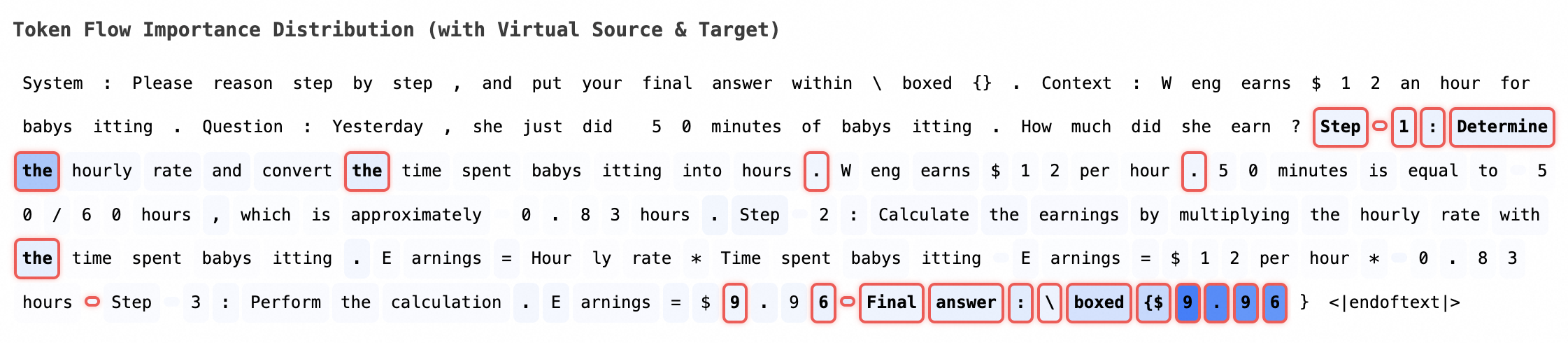
To verify the effectiveness of the method, the authors conducted a visualization analysis on the Qwen3-4B model. Figure 2 shows the answer-oriented token flow importance. By modeling the generation process as a DAG, the paper traces the influence flow from the Prompt to the final answer. Darker nodes in the figure indicate higher flow throughput, identifying decisive token reasoning backbones that go beyond routine filler words. This provides a basis for more fine-grained token-level credit assignment for targeted RL.
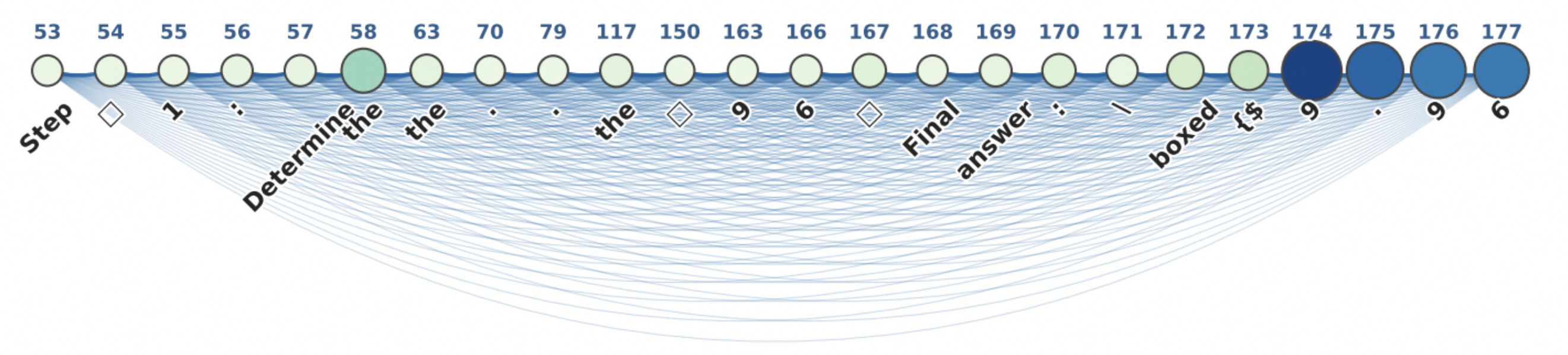
Additionally, Figure 3 uses a word cloud to show the distribution of high-flow and low-flow tokens. This visualization further reveals how FlowTracer distinguishes between key reasoning steps and irrelevant content; high-flow tokens often correspond to core concepts or variables in the reasoning process, while low-flow tokens are mostly filler words or format symbols.
4. Experimental Results and Significance
The paper conducted experiments on multiple reasoning tasks, and the results indicate that FlowTracer can bring consistent performance improvements. By leveraging global structure rather than point-wise heuristics, the method can more accurately identify tokens crucial for answer generation.
4.1 Comparison with Existing Work
- Traditional RL Methods: Typically rely on sparse delayed supervision, making it difficult to accurately estimate token-level value, leading to high attribution noise and instability.
- Internal Signal Heuristics: Such as entropy or attention statistics, utilize internal model dynamics but often ignore the global structure of information propagation.
- FlowTracer: Extracts globally consistent paths via graph theory methods, identifies true transmission hubs, and combines Doob’s h-transform to isolate answer-oriented multi-hop reasoning backbones.
4.2 Enhancement for RLVR
FlowTracer integrates the concept of globally consistent credit into RLVR (Reinforcement Learning with Verifiable Rewards) through token-level reward shaping and loss reweighting. This method not only improves learning efficiency but also enhances reasoning performance, allowing learning signals to focus precisely on tokens that route information to (or away from) the correct answer.
5. Summary
FlowTracer proposes a novel perspective, viewing the reasoning process of LLMs as the propagation of information flow on an attention graph. By constructing an attention-induced DAG and imposing answer conditioning and flow conservation constraints, the method successfully extracts the information flow backbone connecting the question and the answer. This token credit assignment mechanism based on global structure effectively solves the problem of insufficient distinction in token importance in traditional RL methods, providing a new technical path for improving LLM performance in complex reasoning tasks.
This note was included in the arXiv daily digest 20260616. More roundups at blog archive .