Small Data, Big Noise: Adversarial Training for Robust Parameter-Efficient Fine-Tuning
Authors: Eitan Cohen, Idan Simai, Uri Shaham
The authors propose the SDBN framework, integrating adversarial training into Parameter-Efficient Fine-Tuning (PEFT) to enhance model robustness and generalization in low-resource and noisy environments using discrete uncertainty sets.
Paper Summary
Problem
Existing PEFT methods exhibit significant performance drops and poor generalization when training data is scarce or contains text noise (e.g., spelling errors, format inconsistencies), hindering adaptation to real-world deployment.
Method Overview
- Backbone: PEFT (LoRA/Adapter/BitFit)
- Key module: Adversarial Training with Discrete Uncertainty Sets (SDBN-h/SDBN-p)
- Loss: Worst-case Adversarial Loss
Takeaways
Personal understanding — corrections welcome
Experiments demonstrate that adversarial training significantly enhances PEFT's noise resistance in few-shot scenarios without adding parameters, incurring only moderate computational overhead.
Limitations & Questions
SDBN-p relies on LLM-generated variants, potentially increasing computational costs; the coverage of discrete uncertainty sets and their generalizability across tasks need further validation.
Reading Notes
Personal reading notes. Original paper: arXiv:2606.10610v1.
arxiv_id: 2606.10610v1
Paper Reading Note: Small Data, Big Noise: Adversarial Training for Robust Parameter-Efficient Fine-Tuning
Paper ID: 2606.10610v1
Title: Small Data, Big Noise: Adversarial Training for Robust Parameter-Efficient Fine-Tuning
Authors: Eitan Cohen, Idan Simai, Uri Shaham
Affiliation: Bar-Ilan University
1. Research Background and Problem Definition
Parameter-Efficient Fine-Tuning (PEFT) has become a key strategy for adapting foundation models to downstream Natural Language Processing (NLP) tasks. Common PEFT methods include Adapter, BitFit, and LoRA, which significantly reduce computational and storage requirements by updating only a small number of parameters. However, the paper points out that current PEFT methods exhibit significant robustness deficiencies when facing noisy data and limited training data.
In real-world NLP deployments, text data often contains imperfections such as spelling errors, format inconsistencies, or dialectal variations. Furthermore, in domains such as healthcare, aerospace, or endangered languages, training samples are often very limited. The authors observe that although PEFT methods perform well on large-scale corpora, their performance degrades significantly in low-resource settings, and they are highly sensitive to text perturbations (e.g., word swapping).
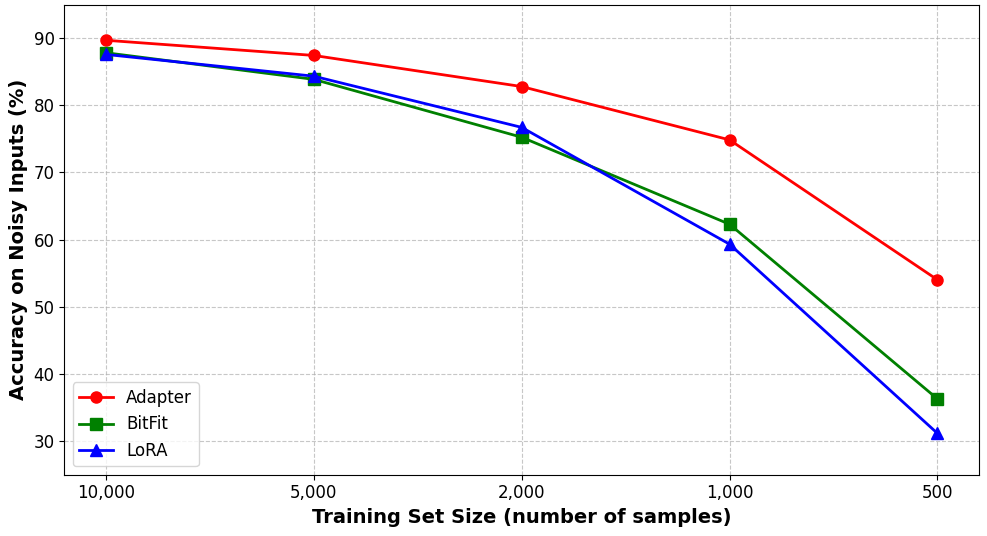
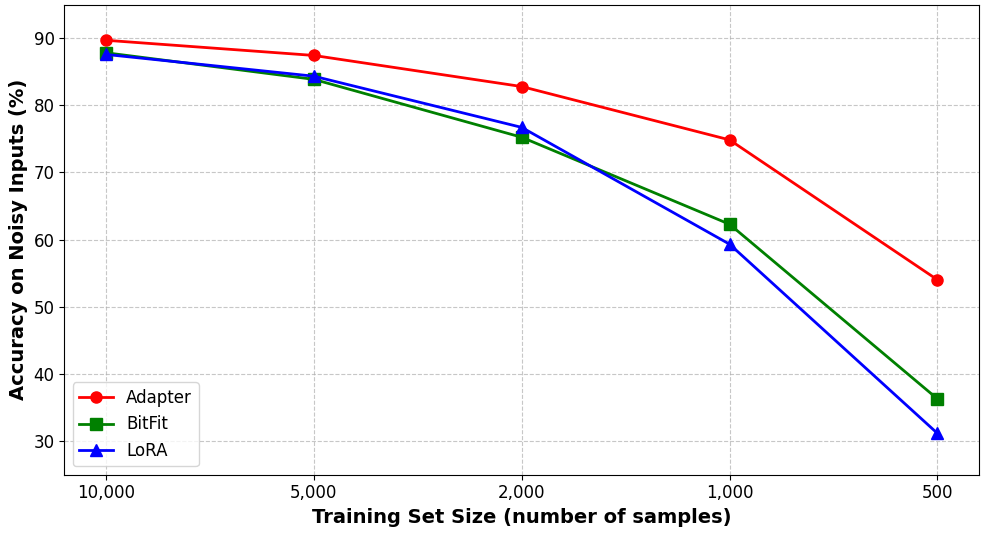
To illustrate this problem intuitively, the paper provides experimental data in the introduction. As shown in Figure 1, as the scale of clean training data (Banking77 dataset) decreases, the accuracy of three common PEFT methods (Adapter, BitFit, LoRA) on a test set containing word-swapping noise drops significantly. In some cases, when the number of training samples is less than 1,000, the accuracy loss exceeds 50%. This trend highlights the vulnerability of current PEFT models to real-world text perturbations in low-resource settings.
2. SDBN Framework Design
To address the above challenges, the authors propose the SDBN (Small Data Big Noise) framework. This is a unified framework designed to introduce Adversarial Training principles into PEFT to enhance model robustness and generalization capabilities.
The paper argues that although adversarial training has been widely adopted for defense against attacks, its application to PEFT methods in low-resource, noisy environments has not been fully explored. The core idea of the SDBN framework is to introduce adversarial perturbations during the fine-tuning process, enabling the model to adapt to worst-case losses, thereby performing more stably in environments where data scarcity and noise interference coexist.
The framework not only focuses on perturbations in the continuous embedding space but is also specifically designed for discrete perturbations unique to the NLP domain. The authors point out that traditional uncertainty sets based on norm balls cannot cover certain specific NLP perturbation scenarios, such as character-level edits that break tokenization or semantically rich generative variants. Therefore, SDBN introduces an instantiation scheme for discrete uncertainty sets to supplement traditional methods.
3. Discrete Uncertainty Set Strategies
To handle different types of noise, the paper introduces two variants of SDBN, both utilizing discrete uncertainty sets to construct adversarial samples:
- SDBN-h (Character-level edits): This variant enumerates character-level edit operations and uses gradients to select the worst-case variant. This method aims to address character-level noise issues that break tokenization.
- SDBN-p (LLM-generated variants): This variant utilizes Large Language Models (LLMs) to generate adversarial variants for robust optimization in generative tasks. This method can produce perturbations that are semantically richer.
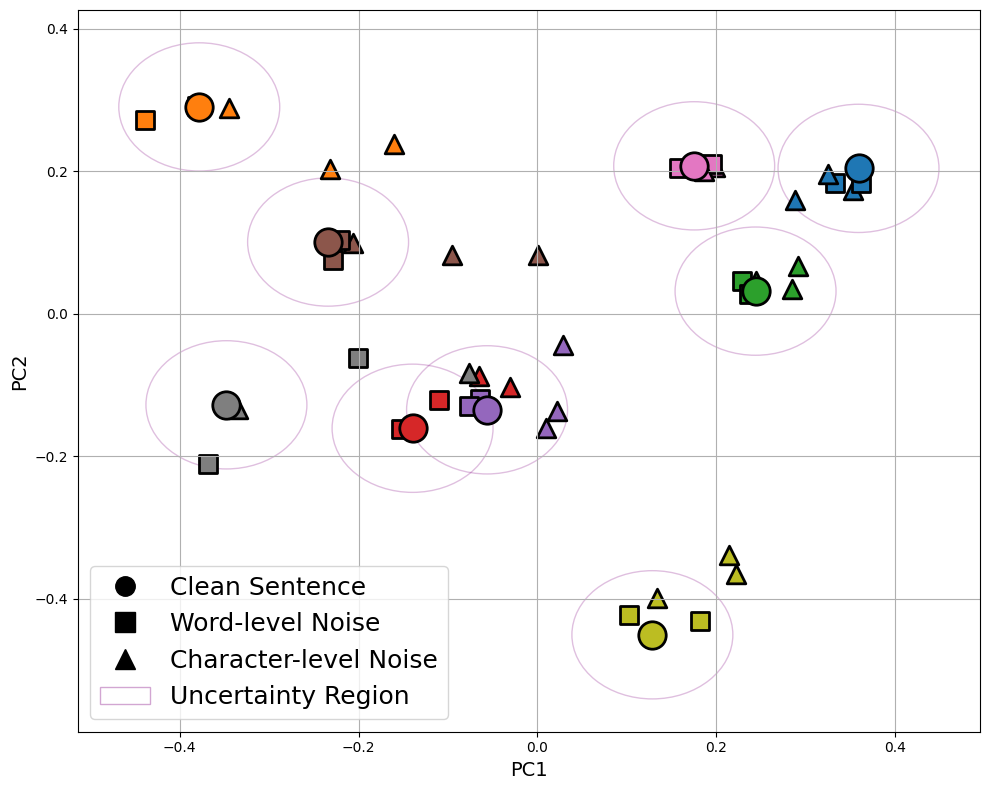
Figure 2 in the paper illustrates the areas covered by adversarial training under different perturbation mechanisms. The figure visualizes perturbations in the embedding space through PCA, explaining how the SDBN framework covers a wider range of robustness requirements through different perturbation strategies (such as continuous vs. discrete perturbations), particularly for character-level and semantic-level changes that are difficult for traditional methods to handle.
4. Experimental Evaluation and Results Analysis
The authors conducted experiments on multiple benchmarks to verify the effectiveness of the SDBN framework in low-resource settings and under different noise types.
4.1 Effectiveness of Adversarial Training in Low-Resource Settings
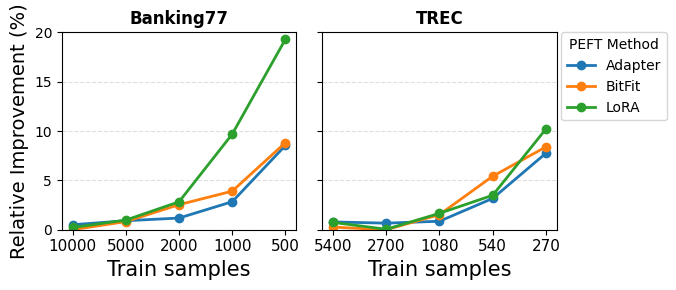
Experiments show that SDBN can significantly improve model performance when training data is limited. Figure 3 illustrates the impact of adversarial training on model performance under limited data conditions. The results show that after introducing adversarial training, the model’s performance in data-scarce scenarios is superior to traditional PEFT baselines, verifying the method’s role in mitigating performance degradation caused by data insufficiency.
4.2 Robustness Under Different Noise Intensities
To evaluate the model’s adaptability to noise of different intensities, the paper compares performance under varying noise levels. Figure 4 shows a performance comparison of adversarial training under variable intensity noise in LoRA PEFT implementations. Experimental results indicate that the SDBN framework can adapt to noise interference of different intensities, and when noise intensity increases, its performance degradation is smaller than that of baseline methods without adversarial training.

4.3 Embedding Space Difference Analysis
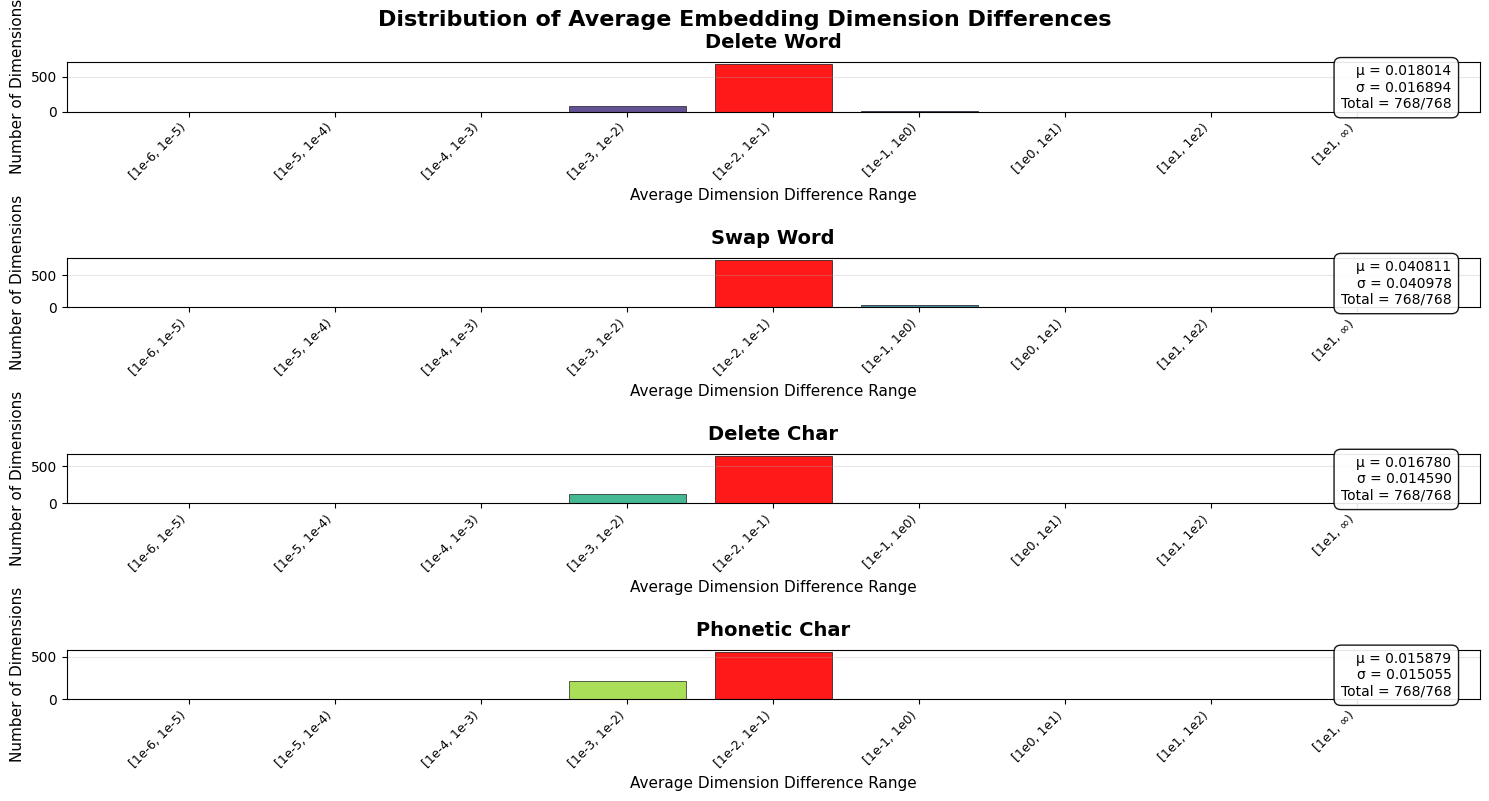
To gain a deeper understanding of the impact of noise on internal model representations, the authors analyzed the embedding differences between noisy sentences and clean sentences. Figure 5 shows histograms of embedding differences between noisy and clean sentences under various noise types. This analysis reveals the distribution differences caused by different types of noise (e.g., word-level vs. character-level) in the embedding space, explaining why certain noises (such as character-level edits) have a greater impact on the model, as they may lead to tokenization failure, resulting in larger offsets in the embedding space.
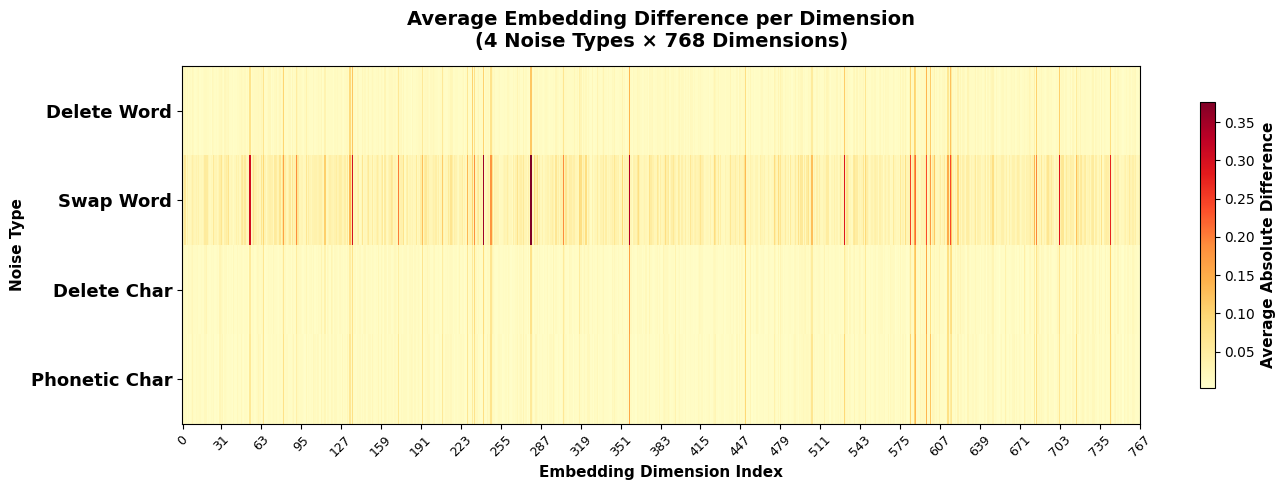
Furthermore, Figure 6 provides a heatmap of coordinate-level embedding differences under various noise types. Each row represents a noise type, showing how noise affects model representations across different embedding dimensions. This visualization analysis supports the authors’ view that character-level perturbations break tokenization and lead to significant offsets in the embedding space, also explaining the necessity of optimizing the SDBN-h variant for such perturbations.
5. Summary and Contributions
In summary, the SDBN framework successfully combines adversarial training with parameter-efficient fine-tuning, addressing the robustness issues of PEFT in low-resource and noisy environments. The main contributions of the paper include:
- Proposed SDBN Framework: Systematically introduced adversarial training into PEFT settings for the first time, specifically targeting robustness improvement in low-resource scenarios.
- Introduced Discrete Uncertainty Set Variants: Proposed two variants, SDBN-h (based on character-level perturbations) and SDBN-p (based on LLM-generated perturbations), addressing robustness challenges in tokenization-breaking and semantic generation tasks, respectively.
- Experimental Validation: Demonstrated significant robustness gains under word-level and character-level corruption in multiple benchmarks without introducing additional trainable parameters, incurring only moderate computational overhead.
The authors believe that SDBN provides a practical solution for deploying reliable language models in real-world scenarios where resources are constrained and noise coexists, filling the research gap in the intersection of PEFT and adversarial training.
This note was included in the arXiv daily digest 20260616. More roundups at blog archive .