
The Confident Liar: Diagnosing Multi-Agent Debate with Log-Probabilities and LLM-as-Judge
Authors: Ali Keramati, Justin Cheok, Jacob Horne, Mark Warschauer
The authors investigate the relationship between token-level log-probability distributions, LLM-as-judge scores, and final task accuracy within multi-agent debates. The paper utilizes a two-agent (Constructor and Auditor) debate architecture, incorporating LLM judges for fine-grained scoring of the reasoning process. It aims to diagnose reasoning quality and task correctness in external evaluations via internal confidence signals.
Paper Summary
Problem
Current evaluations of multi-agent debate systems typically focus solely on final answer correctness, overlooking the quality, coherence, and reliability of intermediate reasoning processes. The authors seek to resolve how to quantify the consistency between internal confidence signals and external reasoning quality assessments, and how to leverage these signals to diagnose reasoning failure patterns.
Method Overview
- Backbone: LLM (用于智能体与法官)
- Key module: 双智能体辩论架构 (Constructor & Auditor), LLM-as-Judge 评分模块
- Loss: N/A (诊断性研究,使用 AUROC 与相关性分析)
Takeaways
Personal understanding — corrections welcome
Experiments reveal a consistent four-stage confidence trajectory throughout the debate process. Significant role asymmetry is observed: the Constructor's confidence alignment with reasoning quality judgment is approximately double that of the Auditor. Confidence-based detection of critical reasoning failures proves more reliable for the Constructor (AUROC 0.804 vs 0.634).
Limitations & Questions
The research relies primarily on experiments within specific domains (e.g., scoring criteria), requiring further verification for cross-domain generalization. LLM-as-judge evaluation may inherently possess subjective bias. Performance variations of internal confidence signals across different model families remain unexplored.
Reading Notes
Personal reading notes. Original paper: arXiv:2606.10296v1.
arxiv_id: 2606.10296v1
arXiv Reading Note | The Confident Liar: Diagnosing Multi-Agent Debate with Log-Probabilities and LLM-as-Judge
1. Research Background and Motivation
Multi-agent debate systems have shown great potential in recent years for improving the reasoning capabilities, robustness, and consistency of Large Language Models (LLMs). However, the paper points out a fundamental challenge in evaluating current such systems: most settings use only the correctness of the final answer as the evaluation signal. This binary signal fails to capture the quality, coherence, or reliability of the intermediate reasoning generated during the debate.
The authors argue that an agent might arrive at the correct answer through flawed reasoning, or produce well-considered arguments that lead to a slightly incorrect conclusion. Evaluating only the endpoints discards the rich intermediate trajectories that debates aim to stimulate. As the complexity of multi-agent pipelines increases, accuracy-based metrics may fail to detect emerging failure modes that are detectable within the structure of agent reasoning.
To address this issue, the paper proposes studying the relationship between three signals in multi-agent debates:
- Token-level log-probability distributions of reasoning tokens (internal confidence signals).
- LLM-as-judge rubric scores assigned to these tokens (external evaluation of reasoning quality).
- Final task accuracy.
2. Core Framework and Evaluation Signals
The paper constructs a systematic investigation framework aimed at studying the triangular relationship of the above three signals across multiple domains (rubric-based scoring, mathematical reasoning, factual Q&A).
2.1 Two-Agent Debate Architecture
The framework proposed by the authors includes a two-agent debate architecture consisting of two roles:
- Constructor: Responsible for generating arguments or solutions.
- Auditor: Responsible for reviewing and evaluating the Constructor’s output.
2.2 LLM-as-Judge Evaluation Mechanism
The framework incorporates an LLM-as-judge module to score the reasoning of each agent. The scoring criteria include:
- Instruction following.
- Justification quality.
- Evidence grounding.
- Critical-failure flag.
This approach aims to evaluate whether an agent’s argument is logically grounded, considers counter-evidence, and substantively engages with the task—dimensions that final accuracy cannot capture.
2.3 Confidence Estimation
The paper utilizes token-level log-probabilities for confidence estimation. Intuitively, if an agent follows a more coherent and evidence-backed reasoning path, the model should assign higher probability mass to the tokens it generates, resulting in a more concentrated logprob trajectory. Conversely, uncertain or contradictory reasoning may manifest as high entropy or spiky probability distributions.
3. Experimental Findings and Key Insights
The paper conducted experiments in the rubric-scoring domain, revealing important findings regarding confidence trajectories and role asymmetry.
3.1 Four-Stage Pattern of Confidence Trajectory
Experimental results show a consistent four-stage confidence trajectory during the debate process. The authors visualized the changes in token-level average confidence across debate rounds.
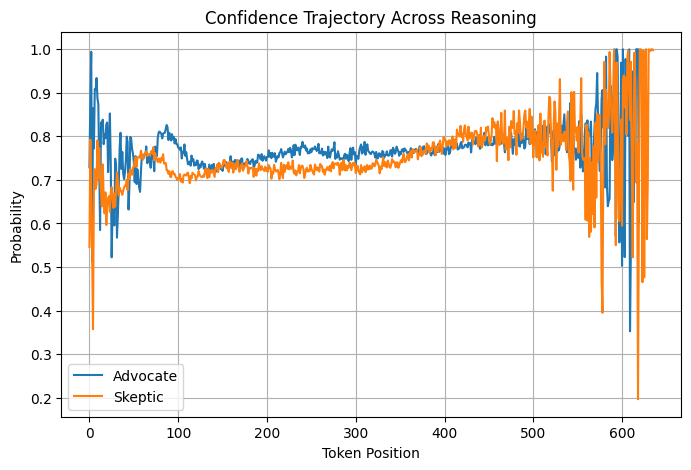
The figure above (Figure 2) shows the trajectory of token-level average confidence across different debate stages. This visualization helps researchers understand how an agent’s internal certainty evolves during different stages of the debate.
3.2 Role Asymmetry
The paper discovered a significant role asymmetry phenomenon:
- Consistency between Confidence and Reasoning Quality: The consistency between confidence and judged reasoning quality is approximately twice as high for the Constructor as for the Auditor.
- Reliability of Critical Failure Detection: Confidence-based detection of critical reasoning failures is more reliable for the Constructor. Specific data indicates that the Constructor’s AUROC is 0.804, while the Auditor’s is only 0.634.
This finding suggests that the diagnostic value of internal confidence signals differs across roles, and a single confidence threshold cannot be simply applied to all debate participants.
3.3 Cross-Signal Correlation
The paper further explored the systematic correlation between logprob distributions, LLM-as-judge reasoning scores, and task accuracy. The study found that this correlation varies with task type, model family, or debate configuration. This divergence can be leveraged to diagnose failure modes in multi-agent debate systems.
4. Research Questions
To guide this cross-domain investigation, the paper proposes three core research questions:
-
RQ 1: Logprob Dynamics in Debate
- RQ 1.1: How do token-level log-probability distributions evolve across debate rounds? Do agents expressing higher confidence reasoning produce higher quality arguments?
- RQ 1.2: Can features based on log-probability predict final task accuracy independently of intermediate reasoning content?
-
RQ 2: LLM-as-Judge Evaluation of Debate Reasoning
- RQ 2.1: How should rubrics be designed to evaluate intermediate reasoning tokens in multi-agent debates? How consistent are LLM judges across different models and protocols?
- RQ 2.2: To what extent do LLM-as-judge scores for intermediate reasoning correlate with final answer correctness across different tasks?
-
RQ 3: Cross-Signal Correlation and Diagnosis
- RQ 3.1: Is there a systematic correlation between logprob distributions, LLM-as-judge reasoning scores, and task accuracy?
- RQ 3.2: Can the divergence between internal confidence signals and external reasoning quality assessments be utilized to diagnose failure modes in multi-agent debate systems?
5. Summary and Outlook
This paper, “The Confident Liar,” provides a new diagnostic perspective for multi-agent debate systems by combining internal generation signals (log-probabilities) and external evaluation signals (LLM-as-judge). The authors argue that focusing solely on final answer correctness ignores intermediate reasoning quality, and by quantifying the relationship between internal confidence and external scores, one can understand agent behavior more granularly.
The main contribution of the paper lies in revealing the asymmetry of confidence signals across different debate roles and proposing the possibility of utilizing this asymmetry to detect critical reasoning failures. Future work will build on these findings to further expand cross-domain investigations, optimizing the design of multi-agent systems to pursue not only answer correctness but also the credibility and quality of the reasoning process.
This note was included in the arXiv daily digest 20260616. More roundups at blog archive .