
Correct Looks Better: Pairwise Comparisons Reveal Accuracy Rankings
Authors: Mina Remeli, Moritz Hardt
The authors transform five established benchmarks into free-form generation evaluations to demonstrate that model rankings derived from pairwise comparisons (e.g., Elo ratings) align highly with accuracy rankings based on ground truth. The study finds that pairwise comparison rankings accurately reflect model performance even with weaker evaluators, while style and bias exert limited influence on overall rankings.
Paper Summary
Problem
The paper investigates whether evaluation rankings based on pairwise comparisons truly reflect model accuracy when ground truth exists, rather than merely rewarding surface style or succumbing to evaluator bias.
Method Overview
- Backbone: LLM Judge (如 gpt-oss-20b)
- Key module: 成对比较聚合算法 (Elo/Bradley-Terry)
- Loss: 无 (评估指标为 Spearman 相关系数等)
Takeaways
Personal understanding — corrections welcome
Experiments indicate a Spearman correlation coefficient exceeding 0.9 between pairwise comparison rankings and accuracy rankings. Pairwise comparisons outperform direct evaluation when evaluators are weaker. In non-discriminative pairs (both correct or both wrong), answer repetition (echo) is identified as the causal factor driving preference.
Limitations & Questions
The study validates only five benchmarks, leaving the universality of the conclusions open to further verification. The selection of evaluator models may influence results. While the echo effect minimally impacts rankings, its interference on individual judgments warrants attention.
Reading Notes
Personal reading notes. Original paper: arXiv:2606.09409v1.
arxiv_id: 2606.09409v1
Paper Reading Note: Correct Looks Better: Pairwise Comparisons Reveal Accuracy Rankings
Research Background and Motivation
With the rapid development of generative AI models, methods for evaluating model performance have undergone significant evolution. Currently, Pairwise Comparisons combined with aggregation algorithms such as Elo or Bradley-Terry have become core tools for evaluating generative models. This approach is particularly popular in open settings like Chatbot Arena, as it is easy to collect data and naturally produces relative rankings in cases where absolute measurement is difficult.
However, there are persistent concerns within the academic community regarding the validity of pairwise comparisons. Critics argue that this method may reward superficial style cues (such as length or format) or reflect the personal biases of the evaluator (Judge), leading to answers that “look better” being selected rather than those that are “actually more correct.” These concerns are particularly prominent in the absence of Ground Truth or when the evaluator’s capability is weaker than that of the models being evaluated.
Based on this, the paper authors, Mina Remeli and Moritz Hardt, propose a fundamental but insufficiently answered question: When ground truth is available, do rankings based on pairwise preferences truly reflect accuracy?
Experimental Setup and Methods
To test this question directly, the authors converted five well-known benchmarks with ground truth (MMLU Pro, GPQA Diamond, Simple QA, GSM8K, BBH) into free-form generation evaluation protocols.
The paper proposes a general evaluation workflow (Figure 2 in the text illustrates this process, described here in text):
- Standard Evaluation Setup: Typically, benchmarks require models to follow specific structures (e.g., multiple-choice questions). The authors converted these into free-form generation tasks by removing options, among other changes.
- Accuracy Ranking: Calculate model accuracy based on ground truth.
- Pairwise Comparison Ranking: Use an LLM as an evaluator (e.g., gpt-oss-20b) to collect pairwise comparison data, and aggregate scores using Elo or Bradley-Terry algorithms.
The authors aim to compare the consistency between these two ranking methods, particularly in scenarios where the evaluator’s capability is weak (Evaluation Frontier).
Core Findings: Alignment Between Pairwise Comparisons and Accuracy
The core finding of the paper is that there is a surprisingly high consistency between preference-based rankings and accuracy-based rankings.
Across the five benchmarks, the authors observed extremely high rank correlation (Spearman’s ρ > 0.9) and linear correlation (R² > 0.87) between preference rankings and ground truth accuracy rankings. This means that even without direct access to ground truth, model ordering almost identical to direct evaluation can be recovered solely through pairwise comparisons.
To more intuitively demonstrate this alignment, the paper provides detailed visual analysis. As shown below, the left side displays model rankings based on accuracy, and the right side displays rankings based on Bradley-Terry scores; the two are highly aligned:
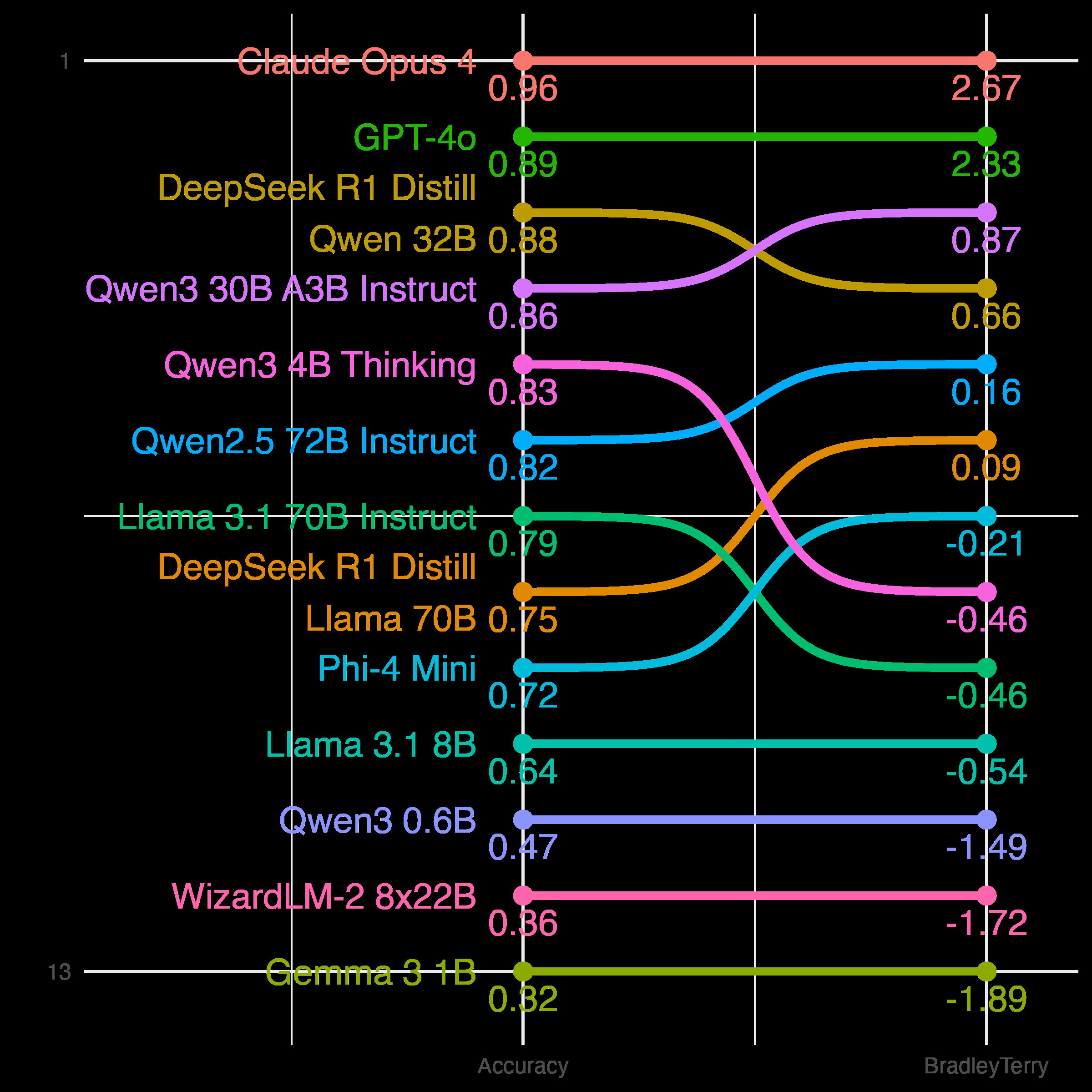
This result indicates that, at least in the tested tasks, pairwise comparisons can effectively capture true differences in model capabilities, rather than just surface features.
Advantages in Weak Judge Scenarios
The paper pays special attention to the “Evaluation Frontier” scenario, where the evaluator model itself cannot reliably solve the task, or is even weaker than the candidate models. Under such extreme conditions, directly asking the evaluator whether an answer is correct often leads to rankings that deviate significantly from the ground truth.
In contrast, even with a weak evaluator, rankings based on pairwise preferences remain well-aligned with accuracy rankings. The paper points out through experimental data that on tasks such as SimpleQA, directly using a weak evaluator to judge correctness can double the ranking distance, whereas pairwise comparisons maintain better ordering effects.
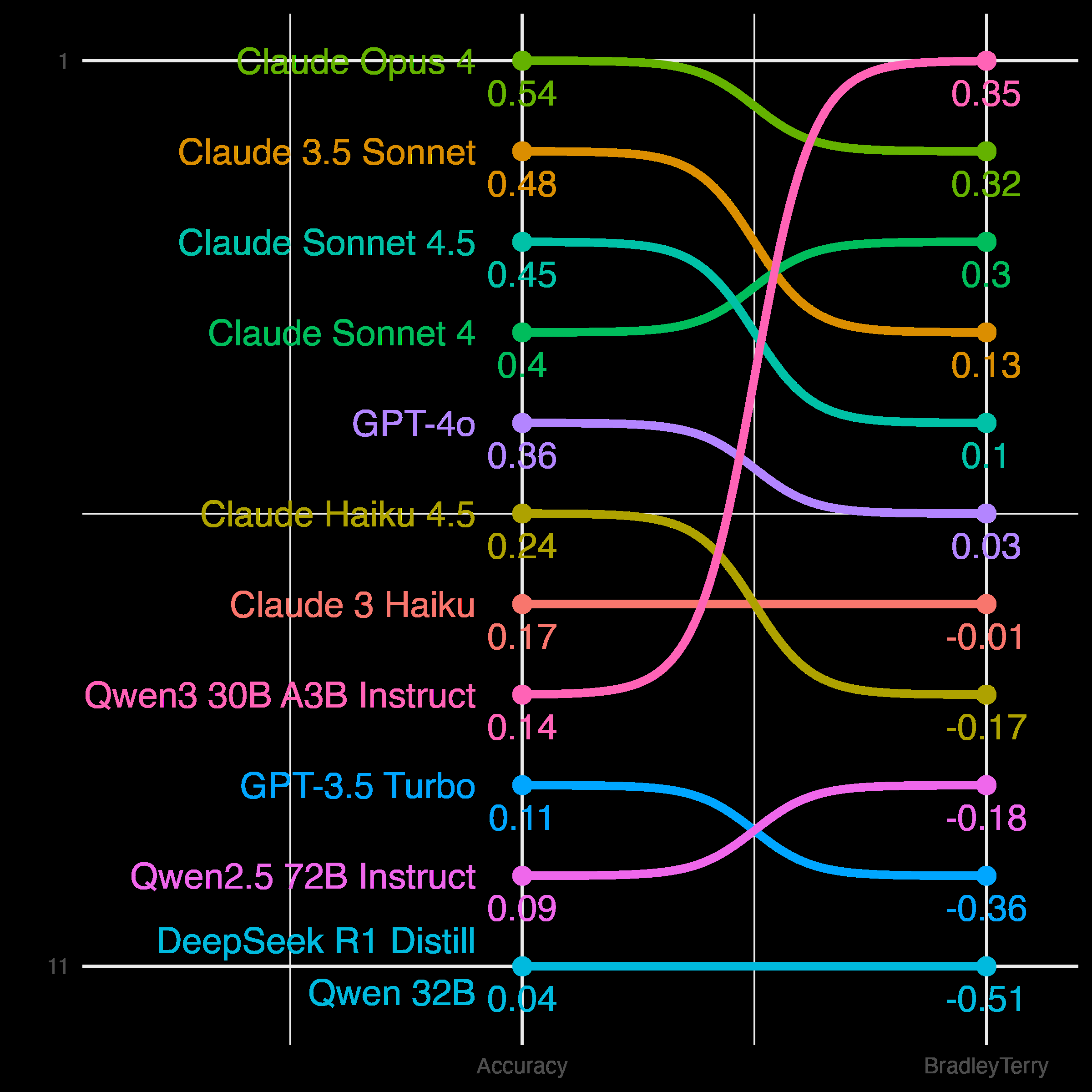
This finding has counter-intuitive implications: we can rank model accuracy through pairwise comparisons without knowing the model’s accuracy. This provides strong theoretical support for evaluating models in scenarios where strong evaluators are lacking or ground truth is scarce.
Analysis of Bias and Style Impact
Despite the excellent performance of pairwise comparisons, the authors did not ignore concerns regarding Style and Judge Bias. Two main sources of bias often mentioned in the literature are style preference and self-preference.
The paper points out that although nearly 60% of pairwise comparisons occur on “Non-discriminative pairs”—where both candidate answers are correct or both are incorrect—the impact of style and bias on the final ranking is very limited. The authors found that correcting these biases has a negligible impact on the ranking.
In non-discriminative pairs, the authors identified a causal driver: Echo. This refers to the model’s behavior of repeating the final answer. The study found that when the correctness of two answers is the same, responses containing an “Echo” (repeating the final answer) are more likely to be preferred by the evaluator. This indicates that while surface cues may affect individual judgments, this influence does not destroy the overall accuracy ranking when aggregated.
Summary and Implications
Through rigorous controlled experiments, this paper provides strong evidence for the validity of the pairwise comparison evaluation method. The main conclusions are as follows:
- Ranking Consistency: Pairwise comparison rankings are highly consistent with ground truth accuracy rankings (Spearman correlation coefficient > 0.9).
- Weak Judge Robustness: When evaluator capability is insufficient, pairwise comparisons outperform direct evaluation and better reflect true capabilities.
- Limited Bias Impact: Style and evaluator bias have a small impact on the overall ranking, although they may affect individual judgments.
- Echo Effect: In non-discriminative pairs, repetition after the answer is a key driver of preference.
The authors believe that these findings alleviate concerns that pairwise comparisons only reward surface style. While style and bias do hinder absolute measurement, their impact on relative rankings is far less than expected. This conclusion has important guiding significance for communities relying on pairwise comparisons for model evaluation (such as Chatbot Arena), indicating that the current evaluation paradigm is reliable in reflecting true model performance.
This note was included in the arXiv daily digest 20260616. More roundups at blog archive .