Riemannian Metric Matching for Scalable Geometric Modeling of Distributions
Authors: Jacob Bamberger, Adam Gosztolai, Pierre Vandergheynst, Michael Bronstein, Iolo Jones
The authors propose a Riemannian metric matching framework utilizing neural networks to learn the Riemannian geometric structure of data. The core involves estimating the carré du champ operator via a denoising probabilistic framework, expressed as the conditional expectation of data random perturbations. This enables sample-level training without explicit kernel construction and amortized inference with constant cost.
Paper Summary
Problem
Estimating the geometric structure of high-dimensional datasets typically relies on graph and kernel methods, where computational costs grow superlinearly with data scale and dimension, and nearest neighbor methods fail in high-dimensional spaces. The paper aims to address the scalability of geometric modeling to achieve efficient and accurate Riemannian geometry learning.
Method Overview
- Backbone: 神经网络代理模型
- Key module: 黎曼度量匹配模块 / carré du champ 算子估计
- Loss: 基于随机扰动的条件期望去噪损失
Takeaways
Personal understanding — corrections welcome
Experiments demonstrate that the method matches or exceeds the accuracy of k-NN-based diffusion geometry estimators while offering inference speeds up to 400 times faster. It supports graph-free geometric analysis on high-dimensional images, overcoming the failure of traditional nearest neighbor methods in high dimensions.
Limitations & Questions
The method relies on the manifold assumption, with theoretical guarantees holding primarily in the infinite data limit. The selection of perturbation parameters during training may impact geometric recovery accuracy, necessitating further validation of robustness across different distributions.
Reading Notes
Personal reading notes. Original paper: arXiv:2606.14334v1.
arXiv ID: 2606.14334v1
Paper Reading Note: Riemannian Metric Matching for Scalable Geometric Modeling of Distributions
1. Paper Overview
This paper proposes a new method called “Riemannian Metric Matching,” aimed at addressing the scalability problem of geometric structure estimation in high-dimensional datasets. The authors point out that although high-dimensional datasets are typically concentrated near low-dimensional structures (manifold hypothesis), traditional graph-based and kernel-based methods suffer from a sharp increase in computational costs as data scale and dimensionality increase.
The core contribution of the paper is proposing a denoising probabilistic framework utilizing neural networks to learn the Riemannian geometric structure of data. Specifically, the authors provide a Riemannian geometry toolbox for downstream machine learning and statistical tasks by estimating the “carré du champ” (CDC) operator combined with Diffusion Geometry. A key observation of this method is that the CDC operator can be expressed as the conditional expectation of random perturbations of data. This enables sample-wise training, constant inference cost, and no need for explicit kernel construction.
2. Background and Challenges
2.1 Manifold Hypothesis and Geometric Analysis
The paper argues that although data in machine learning is typically high-dimensional, empirical evidence suggests that the local intrinsic structure of many real-world datasets is actually low-dimensional. The existence of this low-dimensional structure has motivated the application of geometric tools across various data types to probe intrinsic data properties, such as dimension, tangent spaces, and curvature.
2.2 Limitations of Traditional Methods
The first step in the standard geometric data analysis pipeline is to construct a graph, where nodes correspond to data points and edges encode local connectivity. Such graphs are typically dense (weighted by kernel functions of distances) or sparse (e.g., k-nearest neighbor graphs). The authors point out that while these methods have strong convergence guarantees in the infinite data limit, they become computationally infeasible at large scales:
- Computational and Memory Costs: grow super-linearly or even quadratically with dataset size.
- Inference Efficiency: processing new points requires recomputing nearest neighbors, hindering efficient out-of-sample extension.
- High-Dimensional Failure: in high-dimensional spaces, pairwise distances lose discriminative power, causing distance-based methods to fail.
Furthermore, recent methods utilizing pre-trained neural networks (such as VAEs, GANs, or diffusion models) to extract geometric information typically rely on the network’s Jacobian. The authors argue that these methods lack theoretical guarantees, and computing the Jacobian during inference is costly and numerically unstable.
3. Core Method: Riemannian Metric Matching
3.1 Diffusion Geometry and CDC Operator
The paper reviews diffusion geometry theory, which describes the geometric structure of more general spaces through the behavior of diffusion processes in space. On Riemannian manifolds, diffusion processes are characterized by the Laplace-Beltrami operator, which is related to the Riemannian metric via the carré du champ (CDC) identity.
The authors propose that by learning the CDC operator, one can access the toolbox of classical Riemannian geometry methods, such as intrinsic calculus, curvature, and topology. The CDC operator is defined as the bilinear form of the infinitesimal generator of a Markov diffusion process.
3.2 Conditional Metric Matching Objective
To address the scalability issues of traditional methods, the authors propose training a neural surrogate to directly regress the metric, rather than extracting geometric information from neighborhood graphs or derivatives of pre-trained models.
The paper introduces a denoising-based, sample-level conditional Riemannian metric matching objective. This objective allows for scalable training of the surrogate model without explicitly constructing kernel functions or computing pairwise distances. The authors note that under finite data, the minimizer of this loss function corresponds to classical kernel-based geometric estimators; in the infinite data regime, when data is locally sampled from a manifold, the minimizer can recover the desired geometric quantities.
3.3 Method Architecture
As shown in Figure 1, the method demonstrates the combination of intrinsic diffusion geometry and Riemannian metric matching. The neural network learns the Riemannian metric (represented by the top-left ellipse), implicitly averaging multiple rank-1 contributions through the metric matching loss. This enables researchers to access the Riemannian geometry method toolbox via diffusion geometry.
Based on the learned metric, the paper demonstrates various downstream applications:
- Intrinsic Gradient: Given a scalar field , the intrinsic gradient relative to the data geometry can be computed.
- Local Dimension Estimation: local data dimension is estimated via the ratio of metric eigenvalues (top-right red corresponds to higher dimensions).
- Manifold Interpolation Paths: interpolation paths between data point pairs that remain near the data manifold are computed (bottom-right).
4. Experiments and Results
4.1 Geometric Recovery on Known Manifolds
The authors verify that the metric matching method can recover the correct geometric structure on known data manifolds. Experiments show that the method is comparable to, or even improves upon, k-NN-based diffusion geometry estimators in terms of accuracy.
4.2 MNIST Dataset Analysis
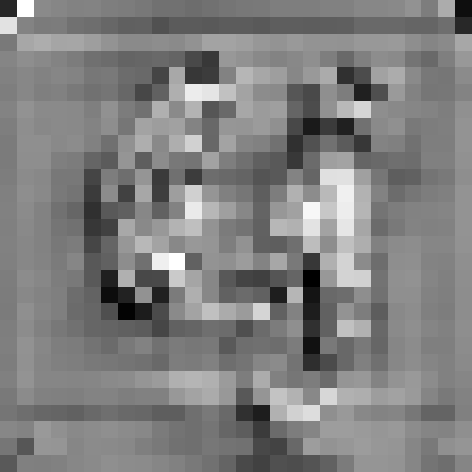
On the MNIST dataset, the authors conducted CDC eigenanalysis. Figure 3 shows the results of CDC eigenanalysis on MNIST, verifying that the learned metric can capture the intrinsic structural characteristics of the data.
4.3 Geometric Analysis of High-Dimensional Image Data
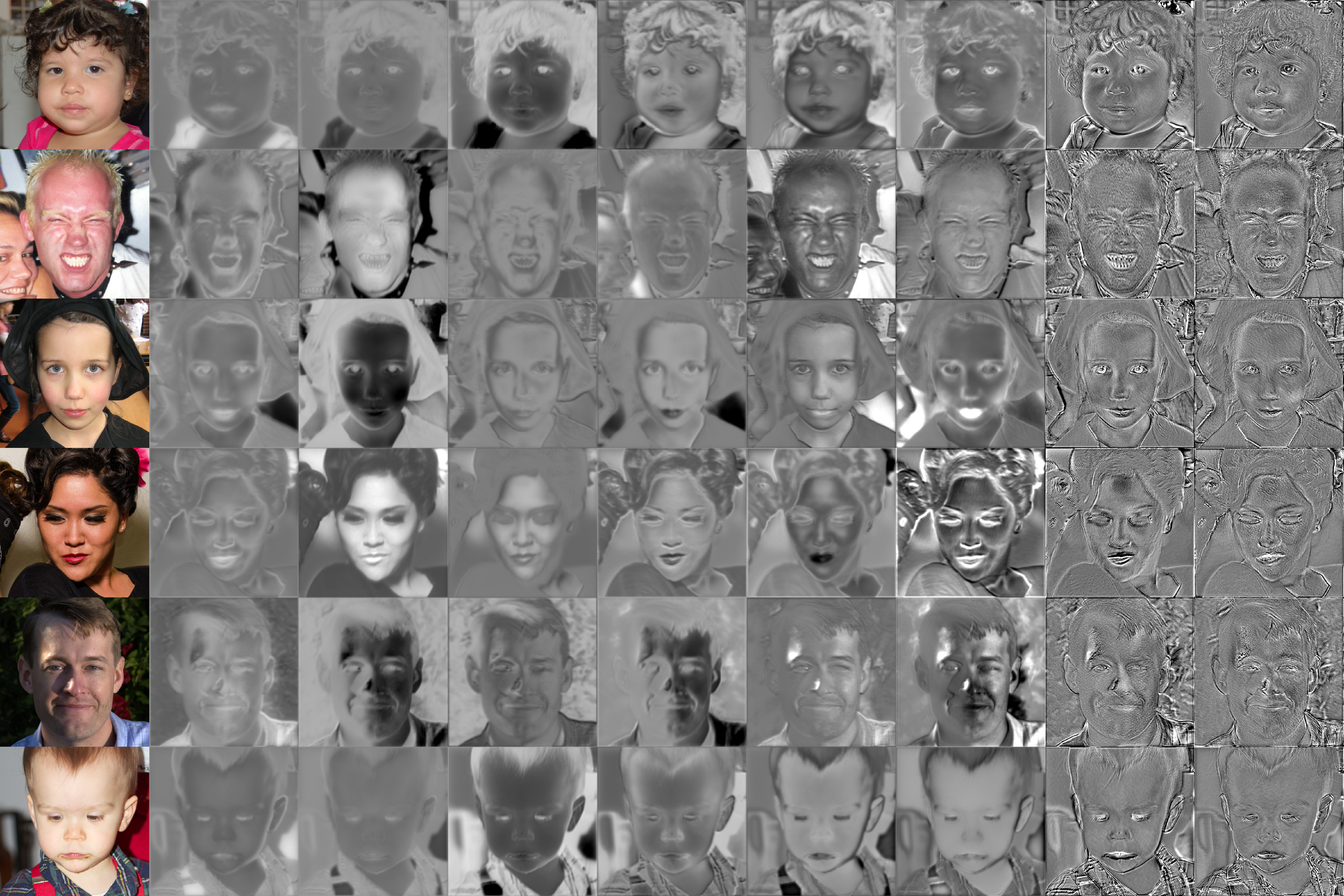
The paper particularly emphasizes the advantages of this method on high-dimensional image data, a scenario where traditional nearest-neighbor-based methods tend to fail. The authors show visualization results of eigenvectors of different orders on the CDC matrix learned by metric matching. Figure 6 shows the visualization of the 1st, 4th, 8th, 16th, 128th, and 256th eigenvectors on the CDC matrix learned by metric matching. These results demonstrate that the method can support graph-free geometric analysis, working even on high-dimensional image data where nearest-neighbor methods fail.
4.4 Performance and Efficiency
Empirical results show that the metric matching method achieves amortized inference, up to 400 times faster than traditional methods. Furthermore, the method supports Riemannian optimization, recovering interpolation paths between data points that remain near the data manifold by computing intrinsic gradients.
5. Summary and Contributions
The paper summarizes the following main contributions:
- Neural Surrogate Model: Proposed a neural surrogate for the CDC operator, achieving amortized inference of local geometric quantities independent of dataset size and without neighborhood graphs.
- Scalable Training Objective: Introduced a denoising-based, sample-level conditional Riemannian metric matching objective, achieving scalable training without explicit kernel construction or pairwise distance computation.
- Theoretical Connection: Established a theoretical connection between the denoising objective and classical diffusion graphs, guaranteeing the recovery of geometric quantities when data is locally sampled from a manifold.
- Empirical Validation: Demonstrated the ability of metric matching to recover correct geometry on known data manifolds, and generated meaningful tangent vectors and high-quality manifold interpolation paths on high-dimensional image data.
The authors believe that by replacing neighborhood graphs with learned, denoising-based surrogates, this method makes diffusion geometry analysis feasible in high-dimensional and large-scale settings, thereby allowing the design of new deep learning methods by directly inheriting Riemannian geometry tools.
This note was included in the arXiv daily digest 20260616. More roundups at blog archive .