
PolyFlow: Safe and Efficient Polytope-Constrained Flow Matching with Constraint Embedding and Projection-free Update
Authors: Jianming Ma, Qiyue Yang, Yang Zhang, Liyun Yan, Zhanxiang Cao
The authors propose the PolyFlow framework, which directly embeds polytope constraints into the flow matching model and dynamics. Through discrete-time flow formulation and a projection-free architecture, it eliminates numerical integration errors and strictly satisfies arbitrary polytope constraints without iterative solvers.
Paper Summary
Problem
Addresses the strict constraint satisfaction problem faced when deploying flow-based generative models in safety-critical physical systems (e.g., robotic control), avoiding the computational overhead and distribution distortion caused by existing post-processing correction methods.
Method Overview
- Backbone: Flow Matching
- Key module: 离散时间流公式化与无投影架构
- Loss: 约束嵌入的流匹配损失
Takeaways
Personal understanding — corrections welcome
Experiments show that the method achieves zero constraint violation across various planning and control tasks while maintaining high distribution fidelity. Compared to existing baselines, it significantly reduces inference latency, demonstrating a good balance between safety, efficiency, and generation quality.
Limitations & Questions
The paper primarily focuses on polytope constraints, and generalization to non-convex or more complex constraint forms requires further verification. Additionally, the long-term stability of the discrete-time formulation in continuous control scenarios needs further observation.
Reading Notes
Personal reading notes. Original paper: arXiv:2606.13400v1.
arxiv_id: 2606.13400v1
PolyFlow: Reading Notes on Safe and Efficient Polyhedral Constrained Flow Matching
Paper Overview
This paper proposes a flow matching framework named PolyFlow, designed to address the strict constraint challenges faced when deploying flow-based generative models in safety-critical physical systems. The authors point out that existing flow matching methods often lack inherent safety guarantees; even if both the source and target distributions lie within the feasible region, trajectories generated by standard flow matching may still violate constraints due to fitting errors or numerical integration errors.
The paper argues that existing constrained generation methods rely heavily on post-processing corrections (such as projection or reflection). This not only incurs high computational costs but may also distort the learned distribution. To this end, the authors propose embedding constraints directly into the model and flow dynamics. Through a discrete-time flow formulation and a projection-free architecture, the method achieves strict satisfaction of arbitrary polyhedral constraints while avoiding expensive iterative solvers.
Core Challenges and Motivation
In the introduction, the authors analyze the core challenges of applying flow models to the physical world (e.g., trajectory planning, robotic control): Safety and Constraint Satisfaction. Unlike image generation, where pixels going out of bounds merely result in visual artifacts, constraint violations in physical systems can lead to hardware damage or catastrophic failures.
The paper indicates that standard flow matching violates constraints primarily due to two factors:
- Fitting Error: There is a deviation between the parameterized neural model and the true target vector field, causing the flow to drift into unsafe regions.
- Numerical Integration Error: Discretization required for sampling introduces numerical errors; larger integration steps may push the state across safety boundaries.
Furthermore, existing post-processing correction methods (such as projecting onto complex polyhedra) are computationally expensive. As external interventions, they may interfere with the learned flow dynamics, leading to distribution matching distortion or convergence to local optima.
PolyFlow Method Architecture
To address the above issues, the authors propose a new design philosophy: embedding constraints directly into the flow definition and model architecture rather than handling them post-hoc. The core contributions of PolyFlow include a discrete-time flow formulation and a projection-free architecture.
Discrete-Time Flow Formulation
To theoretically eliminate the risk of numerical integration errors, PolyFlow reformulates the problem from continuous-time ordinary differential equations (ODEs) to a discrete-time flow framework. The authors prove that the internal safety of conditional flows can guarantee the safety of marginal flows, thereby eliminating numerical integration errors as a source of constraint violations.
Projection-Free Architecture
To ensure the parameterized model inherently respects boundaries, the authors developed a projection-free architecture inspired by the Frank-Wolfe algorithm and ray casting techniques. This design constructs updates that guarantee every step remains within the feasible set, thus avoiding expensive projections or optimization solvers during the inference phase.
The paper presents the overall framework of PolyFlow, as shown below:
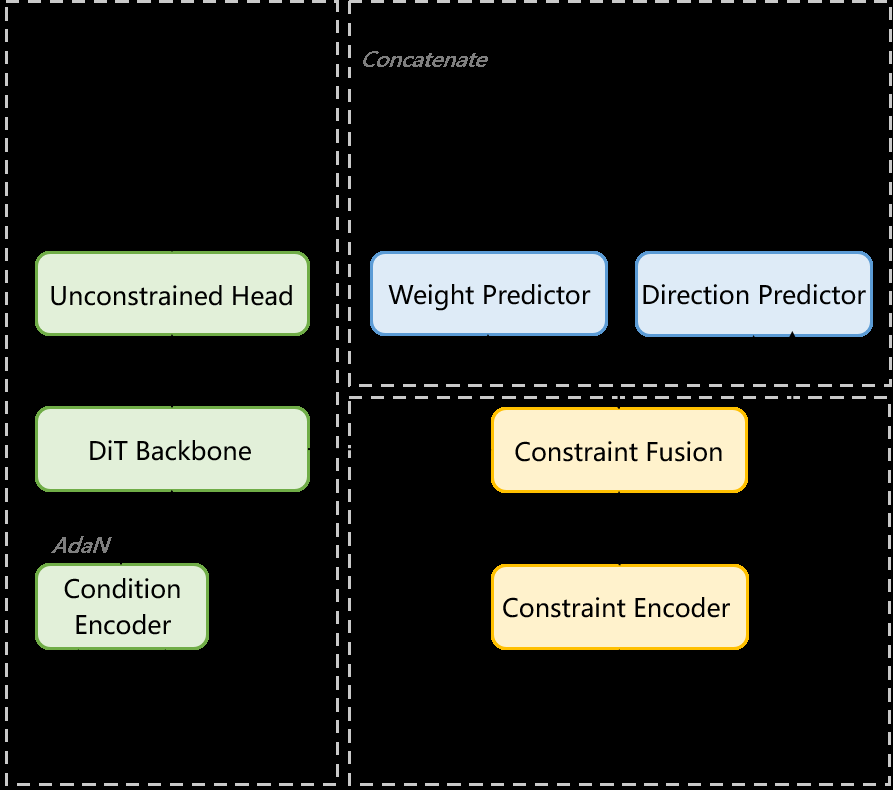
This figure illustrates the overall workflow of PolyFlow, demonstrating how it embeds constraints into the flow matching process, avoiding traditional projection steps.
Experimental Validation and Results
The authors validated the effectiveness of PolyFlow across multiple planning and control tasks. Experimental results indicate that PolyFlow achieved zero constraint violations, outperformed baseline methods in distribution matching quality, and significantly reduced inference latency.
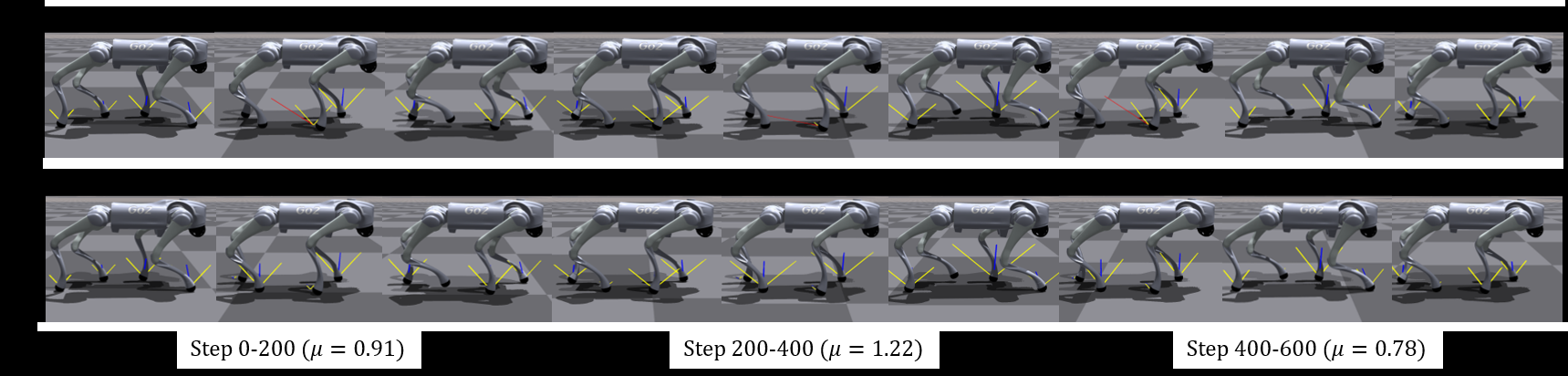
Quadruped Robot Locomotion Task
In the quadruped robot locomotion task, the paper visualizes the ground reaction forces. The yellow lines in the figure represent the friction cone boundaries, verifying that the force vectors generated by the model strictly satisfy physical constraints.
Performance Comparison
Compared to state-of-the-art constrained generation baselines, PolyFlow achieves a favorable balance between safety, efficiency, and generation quality. The relevant work comparison table (Table 1) shows that PolyFlow outperforms methods based on projection, reflection, CBF, or Riemannian flow in terms of constraint generalization capability and inference speed.
Summary and Contributions
The main contributions of this paper are summarized as follows:
- Discrete-Time Flow Formulation: Reformulated flow matching under a discrete-time setting and provided theoretical analysis, eliminating constraint violations caused by numerical integration errors.
- Projection-Free Architecture: Proposed a parameterization method combining ray casting and learnable gating factors, ensuring strict satisfaction of convex constraints by design and avoiding the computational overhead of iterative projection.
- Experimental Validation: Demonstrated that PolyFlow achieves zero constraint violations and superior distribution matching quality in various constrained generation tasks, while significantly reducing inference latency.
The authors believe that PolyFlow provides a new direction for solving general, computationally efficient constrained flow matching frameworks, enabling generative models to be deployed more safely in the physical world. The code is open-sourced at https://github.com/MJianM/PolyFlow.
This note was included in the arXiv daily digest 20260616. More roundups at blog archive .