
Non-Contact Physiological Monitoring in Pediatric Intensive Care Units via Adaptive Masking and Self-Supervised Learning
Authors: Mohamed Khalil Ben Salah, Philippe Jouvet, Rita Noumeir
The paper presents non-contact physiological monitoring in pediatric intensive care units using adaptive masking and self-supervised pre-training.
Paper Summary
Problem
The authors address the PICU scenario by introducing a self-supervised pre-training framework and an adaptive masking module. Leveraging the VisionMamba architecture, the approach resolves motion artifacts and occlusion issues to enhance clinical applicability.
Method Overview
- Backbone: (阅读笔记待补充)
- Key module: (阅读笔记待补充)
- Loss: (阅读笔记待补充)
Takeaways
Personal understanding — corrections welcome
The study emphasizes the introduction of a self-supervised pre-training framework and adaptive masking module for PICU scenarios. It utilizes the VisionMamba architecture to address motion artifacts and occlusion, improving clinical applicability.
Limitations & Questions
Reading notes to be supplemented; discussion welcome.
Reading Notes
Personal reading notes. Original paper: arXiv:2602.15967v1.
Paper Deep Dive: Non-contact Physiological Monitoring in Pediatric Intensive Care Units
1. Research Background and Clinical Challenges
In Pediatric Intensive Care Units (PICU), continuous monitoring of vital signs is crucial for the early detection of clinical deterioration. However, traditional contact sensors (such as pulse oximeters and ECG) have significant limitations: they may cause skin irritation, increase infection risks, and lead to discomfort for the child, especially for premature infants or newborns with fragile skin.
Remote Photoplethysmography (rPPG) offers a non-contact alternative by estimating Blood Volume Pulse (BVP) and heart rate through subtle color changes in facial video. Although rPPG is gaining attention in telemedicine and fitness applications, deployment in PICU environments still faces significant challenges:
- Signal Interference: There are numerous motion artifacts, occlusions (such as catheters, medical staff), and lighting variations in clinical settings.
- Domain Shift: There is a significant difference between laboratory data (e.g., UBFC-rPPG, PURE) and real clinical data, leading to poor model generalization.
- Data Scarcity: Due to ethical and privacy restrictions, labeled clinical video data is extremely scarce, limiting the application of supervised learning.
This paper proposes a framework based on Adaptive Masking and Self-Supervised Learning to address the above issues and achieve robust non-contact monitoring in PICU environments.
2. Core Method: Adaptive Masking and Self-Supervised Framework
The core innovation of this study lies in combining self-supervised pre-training strategies with specific physiological signal features. The overall framework is based on the Masked Autoencoder (MAE) architecture but introduces several improvements to adapt to clinical scenarios.
2.1 Architecture Based on VisionMamba
Unlike traditional Transformers or CNNs, this framework adopts the VisionMamba architecture. Mamba is an architecture based on State Space Models (SSM) with linear computational complexity, making it suitable for processing long-sequence video data and more effectively capturing spatiotemporal dependencies.
2.2 Adaptive Masking Network (AMN)
Traditional MAEs typically use random masking strategies, which might mask areas containing key physiological information. This paper proposes an Adaptive Masking Mechanism:
- Controller: Uses a lightweight Mamba controller trained via Policy Gradient Reinforcement Learning (RL).
- Importance Scoring: The controller assigns an importance score to each spatiotemporal patch.
- Masking Strategy: Prioritizes masking high-information areas containing strong pulsatile signals. This forces the model to learn more general, physiologically meaningful representations rather than simply reconstructing easily predictable backgrounds.
This method allows the model to implicitly focus on facial areas rich in pulse signals without explicit Region of Interest (ROI) extraction.
Schematic diagram of the overall framework architecture (from embedded figure on page 5 of PDF)

Details of the adaptive masking mechanism and Mamba controller (from embedded figure on page 5 of PDF)
2.3 Curriculum Learning Strategy
To address domain shift and data scarcity issues, the training process is divided into three stages, gradually increasing difficulty:
- Stage 1: Initial learning on clean public datasets (e.g., UBFC-rPPG).
- Stage 2: Introduction of synthetic occlusion scenarios to simulate interference in clinical environments.
- Stage 3: Large-scale pre-training on unlabeled real PICU videos of 500 pediatric patients.

Flowchart of the three-stage curriculum learning strategy (from embedded figure on page 5 of PDF)
2.4 Teacher-Student Distillation
To solve the problem of lack of labels in clinical data, the study adopts a knowledge distillation strategy:
- Teacher Model: A supervised expert model trained on public datasets, providing high-quality latent physiological signal guidance.
- Student Model: A self-supervised model trained on PICU data.
- Goal: The student model not only performs masked reconstruction but also aligns with the teacher model’s predictions through distillation loss, thereby introducing physiological inductive bias.
Teacher-student distillation training setup (from embedded figure on page 5 of PDF)
Additionally, the generation objective combines Mean Squared Error (MSE) and pixel-level Pearson Correlation to ensure accurate modeling of BVP temporal dynamics.
3. Experimental Setup and Datasets
3.1 Datasets
- Public Datasets: Used for pre-training and comparative experiments, including UBFC-rPPG and PURE, etc., which were collected under controlled conditions.
- Clinical Dataset: The research team used an Institutional Review Board (IRB) approved dataset containing videos of 500 pediatric patients. This is a highlight of this study, providing validation in a real clinical environment.
3.2 Evaluation Metrics
The main evaluation metric is Mean Absolute Error (MAE), in units of bpm (beats per minute).
4. Results and Analysis
Experimental results indicate that the framework has significant superiority in the PICU environment.
4.1 Performance Improvement
- Comparison with Standard MAE: Compared to the standard Masked Autoencoder, MAE was reduced by 42%.
- Comparison with SOTA Models: Outperforms the PhysFormer model by 31%.
- Final Accuracy: Achieved a final MAE of 3.2 bpm, which is a practically useful accuracy level for clinical monitoring.
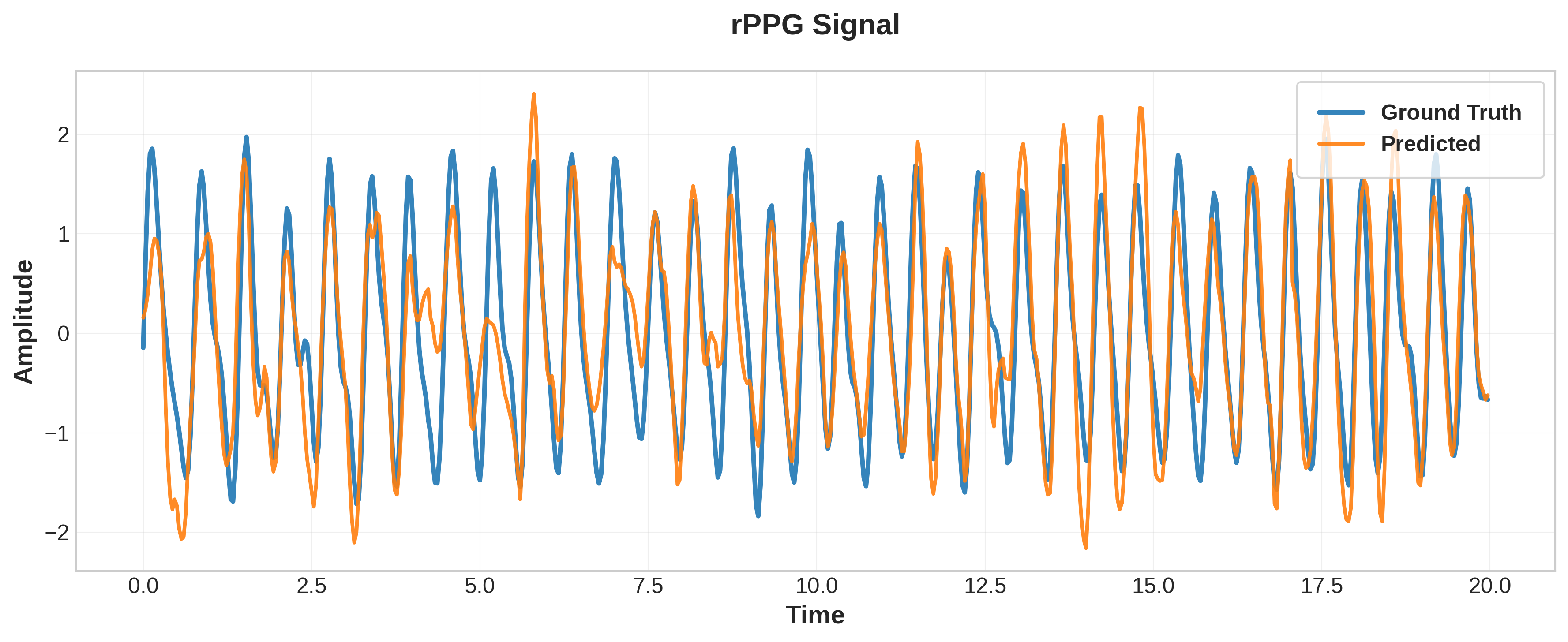
Performance comparison results of different models (from embedded figure on page 16 of PDF)
4.2 Robustness and Attention Mechanism
The model is able to consistently focus on pulse-rich areas without explicit ROI extraction. The model demonstrated good robustness in the presence of clinical occlusions and noise. The adaptive masking mechanism effectively guides the model to learn key features rather than being disturbed by background noise.
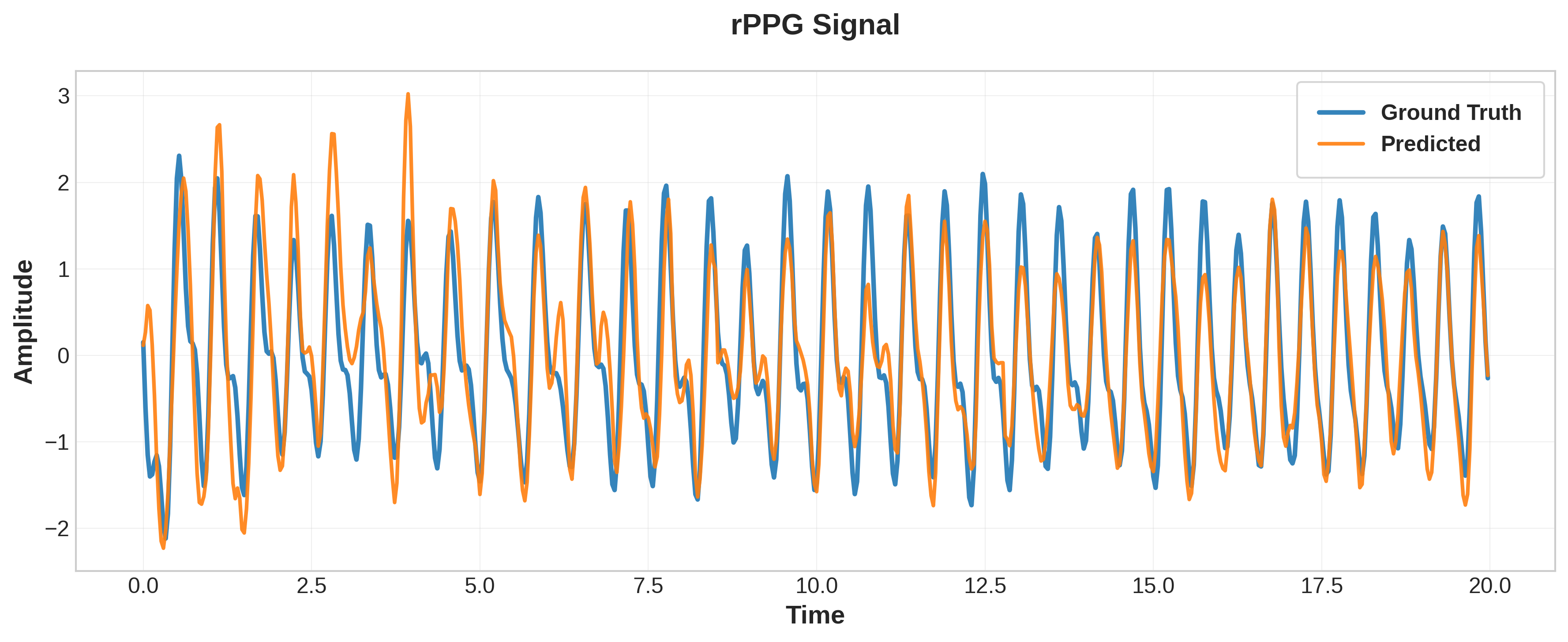
Analysis of model attention distribution and robustness under occlusion (from embedded figure on page 16 of PDF)
5. Summary and Outlook
This paper proposes a non-contact physiological monitoring framework for Pediatric Intensive Care Units (PICU). By combining the VisionMamba architecture, Adaptive Masking Mechanism, Curriculum Learning, and Teacher-Student Distillation, this study successfully addresses key issues such as motion artifacts, occlusion, and data scarcity in clinical environments.
Summary of Major Contributions:
- Proposed a PICU non-contact framework that reduces the risk of skin injury and enables continuous physiological monitoring.
- Designed a self-supervised rPPG framework combining masked autoencoding, Pearson correlation, and physiological distillation.
- Introduced an adaptive masking strategy based on a Mamba controller, improving robustness to occlusion and lighting changes.
- Validated the effectiveness of the method on a large IRB-approved dataset containing 500 pediatric patients.
Future Outlook: Although this framework has made significant progress in single-modal video heart rate monitoring, future work could explore multimodal fusion (e.g., combining infrared or thermal imaging) and expand to monitoring more physiological parameters (such as respiration rate, blood oxygen saturation) to further support clinical decision-making.
This note was included in the arXiv daily digest 20260614. More roundups at blog archive .